The Name Failure-is-the-mother-of-success.php in Chinese/Japanese on a Personalized Wall Scroll.
Click the "Customize" button next to your name below to start your personalized failure-is-the-mother-of-success.php calligraphy artwork...
Switched to secondary search mode due to lack of results using primary.
These secondary results may not be very accurate. Try a different but similar meaning word or phrase for better results. Or:
Look up in my Japanese Kanji & Chinese Character Dictionary(My dictionary is a different system then the calligraphy search you just tried)
If you want a special phrase, word, title, name, or proverb, feel free to contact me, and I will translate your custom calligraphy idea for you.
1. 1. Right Understanding / Right Perspective / Right View / Perfect View
2. Even a fool may sometimes come up with a good idea
4. Achievement / Accomplishment
6. Any success cannot compensate for failure in the home
7. No man knows what he owes to his parents until he comes to have children of his own
8. Armor
10. Without a big net, how can you catch fish?
11. Bond
12. Bounce Back / Stage a Comeback
13. You May Learn from Victory, You Will Learn from Failure
14. Confucius: Golden Rule / Ethic of Reciprocity
16. Diligence
17. Doctor
18. Do not fear the task: Cooperation will lead to success
19. The Spirit of the Dragon Horse
20. The Spirit of the Dragon Horse and Power of a Tiger
21. Dream Come True / Enjoy Success
22. Dripping Water Penetrates Stone
23. Eagle Claw Overturning Fist
24. Let Us Try
25. Eternal Love
26. Experience is the Mother of Wisdom
29. Failure is the Origin of Success
30. Failure is the Mother of Success
32. Fate / Opportunity / Chance
33. Five Elements
34. A Bright Future
35. Flourish
37. Dear Grandfather
39. Dear Grandfather
41. Dear Grandmother
43. Dear Grandmother
45. Dear Grandmother
47. Dear Grandmother
50. Honor
51. Even The 100-Foot Bamboo Can Grow One More Foot
52. Justice / Rectitude / Right Decision
53. Learn From Your Predecessors
54. You May Learn from Victory, You Will Learn from Failure
55. A Life of Happiness and Prosperity
56. Life Energy / Spiritual Energy
57. Loving Mother
59. Mother
61. Love for Parents
62. Mother and Son
63. Mother Nature
64. A Mother’s Love / Motherly Love
65. Nature in Balance / Balanced Nature
66. No arrogance in victory, No despair in defeat
67. Do not fear being slow, fear standing still
68. Opportunity
69. Love Between Child and Parents
70. Appreciation and Love for Your Parents
72. Realize Your Ambitions / Ride on the Crest of Success
74. Reiki
75. Respect
76. Not Only Can Water Float A Boat, It Can Sink It Also
78. Japanese Snapping Turtle / Chinese Soft Shell Turtle
79. Success
80. Failure is a Stepping Stone to Success
81. The More We Sweat in Training, The Less We Bleed in Battle
82. Sword
83. Taekwondo
85. Turtle
86. Win / Victory
87. Each Time You Stumble and Fall, You Gain Experience and Wisdom
88. Wolf
1. Right Understanding / Right Perspective / Right View / Perfect View
Samyag Dristhi / Samyag Drsti / Samma Ditthi
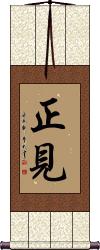
正見 is one of the Noble Eightfold Paths of Buddhism. Right View, along with the Right Thought, constitutes the path to Wisdom.
To get to the correct view of the world, you must first understand and follow Four Noble Truths.
Note: This term is exclusively used by devout Buddhists. It is not a common term, and remains an unknown concept to most Japanese and Chinese people.
See Also: Buddhism | Enlightenment | Noble Eightfold Path
Even a fool may sometimes come up with a good idea
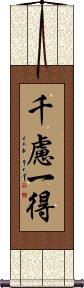
千慮一得 means “1000 tries, one success,” or “[a] thousand tries [leads to] one success.”
This proverb is a humble way to express your success, ideas, or accomplishments. It carries the self-deprecating implication that you simply got lucky when inventing or creating something.
Translations for this proverb include:
Even without any notable ability on my part, I may still get it right sometimes by good luck.
Even a fool may sometimes come up with a good idea.
Compare this to the English idiom, “Even a broken clock is right twice a day.”
Eight Black Horses
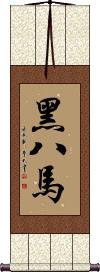
黑八馬 means “eight black horses” in Chinese.
This is an unusual title for calligraphy, but several people have searched for it, so we added it.
Eight horses are a sign of success in business in Chinese culture.
Achievement / Accomplishment
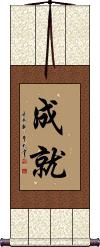
成就 is the word most often used in Chinese, Korean and Japanese to mean accomplishment or achievement.
成就 can also be used to mean success, attain a result, fulfillment, realization, or completion.
Always Try to do Better
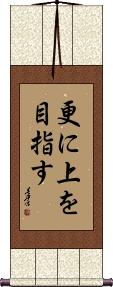
This Japanese proverb literally translates as: [After having achieved a fair degree of success,] one should still try to do better.
Others may translate this as “Always try to improve,” or “Always try to be better.”
Note: Because this selection contains some special Japanese Hiragana characters, it should be written by a Japanese calligrapher.
See Also: Never Give Up
Any success cannot compensate for failure in the home
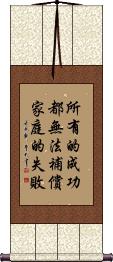
所有的成功都無法補償家庭的失敗 is a Chinese proverb that can be translated into English as “No success can compensate for failure in the home.”
Also, the word “home” can be exchanged with “family.”
No man knows what he owes to his parents until he comes to have children of his own
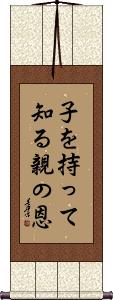
子を持って知る親の恩 literally translates as: Only after you have a baby, you would appreciate your parents (feel the way they do, etc).
This is a bit like the “walk a mile in another man's shoes” saying. it's about you cannot fully understand the plight of others until you experience it yourself. It also shows appreciation for the plight of parents.
This Japanese proverb can also be translated a few more ways:
No man knows what he owes to his parents till he comes to have children of his own.
One knows not what one owes to one's parents till one comes to have children of one's own.
Only after you have a baby, you will appreciate your parents or feel the way they do.
Only after becoming a parent yourself do you realize how much you owe [how indebted you are] to your own parents.
Note: Because this selection contains some special Japanese Hiragana characters, it should be written by a Japanese calligrapher.
Armor
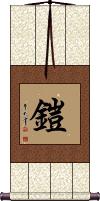
鎧 is a simple way to write armor/armour in Chinese, Japanese Kanji, and old Korean Hanja.
 This can also be Yoroi (a Japanese place name). It can also refer to mail as chain mail.
Wisdom from Hard Knocks
The school of hard knocks
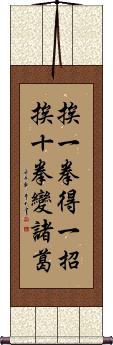
挨一拳得一招挨十拳變諸葛 is a Chinese proverb that literally translates as: Receive one blow, [and one] learns a lesson; Receive ten blows, [and one] becomes a great Zhuge [Liang].
You must first understand that a man named Zhuge Liang was one of the great strategists and philosophers in Chinese history. He's known as a man of great wisdom.
Figuratively, this phrase means:
One can learn much from failure or “hard knocks.”
Without a big net, how can you catch fish?
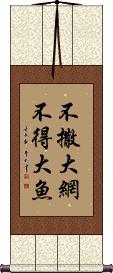
不撒大網不得大魚 is a Chinese proverb that literally translates as: [if one does] not cast a big net, [one can] not get big fish.
Figuratively, this means: One cannot make great accomplishments without making great efforts or taking great pains.
This is sort of the fishing version of, “No pain, no gain.”
Bond
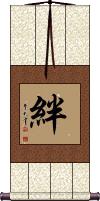
This Kanji represents a bond, as in the bond between mother and daughter, father and son, family ties, or a family bond.
絆 is the type of character that says, no matter what happens (difficult times), we have this bond that cannot be broken.
If you go to the Japanese dictionary, the definition is the bonds (between people), (emotional) ties, relationship, connection, link, tether, or fetters.
Read this before ordering...
This Kanji is best if your audience is Japanese. While this is also a Chinese character, it has a completely different meaning in Chinese (it means to hinder or stumble in Chinese).
it’s
a very rare character in Korean Hanja but does mean bond in Korean (used in Korean words for certain kinds of glue and sticking plaster).
Bounce Back / Stage a Comeback
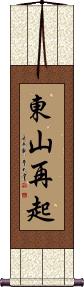
東山再起 is a Chinese proverb that means “make a comeback” or “resuming after a failure.”
It's sometimes used in terms of losing a job and then getting it back. However, it applies to any type of comeback after difficulty.
The literal meaning of this Chinese idiom is, “[The] Eastern Mountain Again [will] Rise.”
You May Learn from Victory, You Will Learn from Failure
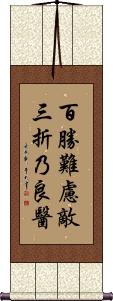
百胜难虑敌三折乃良医 is a Chinese proverb that literally translates as: [Even a general who has won a] hundred victories [may be] hard put to see through the enemy's [strategy], [but one who has] broken [his] arm three [times] [will] be a good doctor.
Figuratively, this means: One cannot always depend on past successes to guarantee future success but one can always learn from lessons drawn from failure.
See Also: Failure is the Mother of Success | Success | Time | Schooled by Experience and Hard Knocks
Confucius: Golden Rule / Ethic of Reciprocity
Do not do to others what you do not want done to yourself
Some may think of this as a “Christian trait,” but actually, it transcends many religions.
This Chinese teaching dates back to about 2,500 years ago in China. Confucius had always taught the belief in being benevolent (ren), but this idea was hard to grasp for some of his students, as benevolence could be kind-heartedness or an essence of humanity itself.
When answering Zhong Gong's question as to what “ren” actually meant, Confucius said:
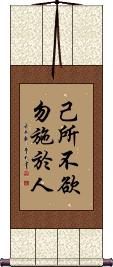
己所不欲勿施于人 or “When you go out, you should behave as if you were in the presence of a distinguished guest; when people do favors for you, act as if a great sacrifice was made for you. Whatever you wouldn't like done to you, do not do that thing to others. Don't complain at work or home.”
Hearing this, Zhong Gong said humbly, “Although I am not clever, I will do what you say.”
From this encounter, the Chinese version of the “Golden Rule” or “Ethic of Reciprocity” came to be.
The characters you see above express, “Do not do to others whatever you do not want to be done to yourself.”
See Also: Tea | Benevolence
Determination to Achieve
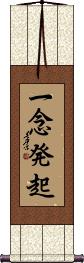
一念発起 is a Japanese proverb, “Ichinen Hokki,” which suggests being resolved to do something or having a wholehearted intention to accomplish something.
Some will translate this as “the determination to accomplish something,” or “turning over a new leaf and being determined to find success.”
Diligence
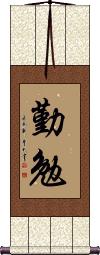
勤勉 can mean diligence, industrious, assiduity, assiduous, diligent, or sedulity.
Diligence is working hard and doing your absolute best. You take special care by doing things step by step. Diligence helps you to get things done with excellence and enthusiasm. Diligence leads to success.
See Also: Hard Work | Tenacious / Tenacity | Commitment | Passion for a Cause
Doctor
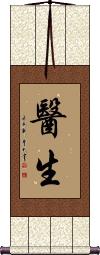
醫生 is the title used to refer to medical doctors or physicians in China.
Note: Sometimes, this same term is used in Korean, but not common.
The meaning is close to “healer [of] life” as the first character, 醫, can mean medicine, the healing art, healing, curing, medical, to cure, or to treat. The second character, 生, means birth or life.

 In Japan, they use a simplified version of the first character (医生 is also used as the Simplified Chinese version of Doctor). If you want this version, please click the characters to the right instead of the button above.
Do not fear the task: Cooperation will lead to success
Do not fear strong winds waves; just be sure to row in unison
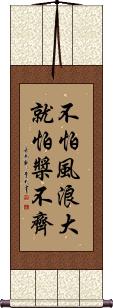
不怕风浪大就怕桨不齐 is a Chinese proverb that literally translates as: Do not fear strong winds [and] high waves; what [one should] worry about whether or not you're rowing in unison.
Figuratively, this means: However difficult the task, the key to success lies in making collective efforts.
I like to translate this as “Don't sweat the details, just get together and get it done.”
The Spirit of the Dragon Horse
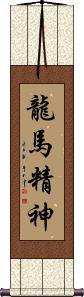
龍馬精神 is an old proverb that is used to wish someone good health and success combined as a great compliment.
The meaning is “The vigor and spirit of the legendary dragon-horse.” These four characters are often accompanied by four more which mean “...and the power and prestige of the tiger.” Here we are just offering the first part which is considered the short version.
By giving a wall scroll like this to someone, you were either wishing or telling them that they have an amazing quality. There is also a suggestion of good health - at least anyone with the vigor of a dragon horse would seem to also be in good health.
Note: In Japanese, this would be read as the spirit of 坂本龍馬 (Sakamoto_Ryōma), a beloved rebel who helped abolish the old Japanese feudal system. This can be confusing, so I am declaring this proverb to be Chinese only.
The Spirit of the Dragon Horse and Power of a Tiger
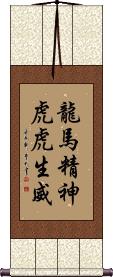
龍馬精神虎虎生威 is an old proverb that is used to wish someone great health and success combined as a great compliment.
The meaning is “The vigor and spirit of the legendary dragon-horse and the power and prestige of the tiger.”
By giving a wall scroll like this to someone, you were either wishing or telling them that they have these qualities. There is also a suggestion of good health - at least anyone with the vigor of a dragon horse would seem to also be in good health.
Dream Come True / Enjoy Success
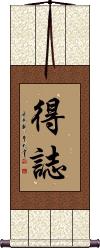
得誌 is a Chinese word that means to accomplish one's ambition, a dream come true, or to enjoy your success.
Dripping Water Penetrates Stone
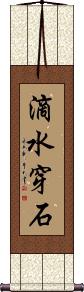
滴水穿石 is a Chinese proverb that means, dripping water penetrates stone.
The figurative meaning can mean:
Constant perseverance yields success.
You can achieve your aim if you try hard without giving up.
Persistent effort overcomes any difficulty.
While 滴水穿石 is the most common character order, you will likely see 水滴石穿, might see 滴水石穿, and will rarely see 小水穿石 in the wild.
Eagle Claw Overturning Fist
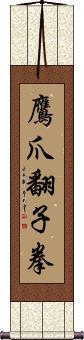
鷹爪翻子拳 is the title of a Chinese martial arts style known as “Ying Zhua Fan Zi Quan” or “Eagle Claw Overturning Fist.”
This style was derived from a combination of 鷹爪派 (Eagle Claw School) and 子母拳 (Son-Mother Fist). The title “son-mother” may seem odd, but it refers to a fist or punches seemingly coming out of another fist or punch. In modern times, 子母彈 is a title for “cluster bomb” (bombs coming out of another bomb).
Let Us Try
Essayons
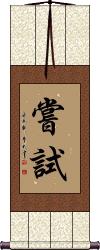
嘗試 is a close match for the English phrase “let us try” or the French word “Essayons.”
 Essayons the motto of Combat Engineers in the U.S. Army.
This word can also be translated as “to try” or “to attempt.”
Even if you're not a Combat Engineer, this word should inspire you to attempt to accomplish difficult things. If you don't try, you are certain to fail; if you do try, at least there is a chance of success.
The worst thing is not failure, the worst thing is not trying at all.
Eternal Love
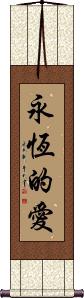
永恆的愛 is the best way to write “Eternal Love” in Chinese.
The first two characters mean eternal, eternally, everlasting, and/or perpetual.
The third character is a possessive article which sort of makes this selection mean “Love of the eternal kind.”
The last character is “love.”
This version is best if your audience is Chinese. We also have a Japanese version of eternal love.
See Also: Forever Love | Love
Eternal Love
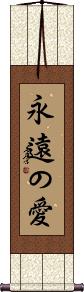
永遠の愛 is a great way to write “Eternal Love” in Japanese.
The first two characters mean eternal, eternity, perpetuity, forever, immortality, and permanence.
The third character is a possessive article which sort of makes this selection mean “Love, of the eternal kind.”
The last character is “love.”
Cultural note: Most of the time, it is taboo to use the word “love” in Japanese. For instance, a Japanese man will say, “I like you,” rather than, “I love you,” to his spouse/girlfriend. However, this entry for eternal love is acceptable because of the way it is composed.
This entry is only appropriate if your audience is Japanese. We also have a Chinese version of this eternal love.
See Also: Forever Love | Love
Experience is the Mother of Wisdom
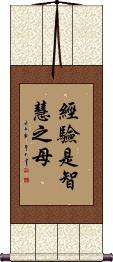
It's been said that wisdom comes from good judgment, and good judgment comes from experience, while experience comes from a series of times when you used bad judgment.
經驗是智慧之母 is a Chinese proverb that makes the simplest connection between experience and wisdom.
See Also: Failure is the Mother of Success | Wisdom | Learn From Wisdom
Failure in Not an Option
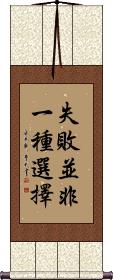
失敗並非一種選擇 is probably the best way to say, “Failure is not an option,” in Chinese.
Just don't forget that some ancient Chinese proverbs suggest that failure is a learning opportunity that leads to success or innovation. So don't plan to fail but failure is only a waste if nothing is learned from the failure.
See Also: Failure is a Stepping Stone to Success | Failure is the Mother of Success
Failure is Not an Option
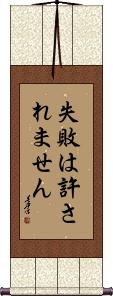
失敗は許されません means “failure is not an option,” in Japanese.
This can also be translated as “failure is not allowed/acceptable.”
Note: Because this selection contains some special Japanese Hiragana characters, it should be written by a Japanese calligrapher.
Failure is the Origin of Success
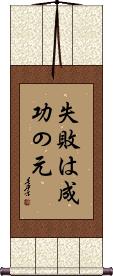
This Japanese proverb reads, “failure/mistake/blunder/defeat is the origin of success.”
It suggests that failures or defeats are a necessary part of success.
失敗は成功の元 is often translated as “Failure is a stepping stone to success.”
Note: There are a few similar variations of this idiom in Japanese.
Note: Because this selection contains some special Japanese Hiragana characters, it should be written by a Japanese calligrapher.
See Also: Failure is a Stepping Stone to Success
Failure is the Mother of Success
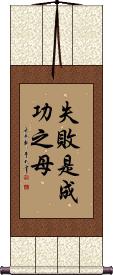
失败是成功之母 is a Chinese and Korean proverb that means “Every failure that you experience is a chance to learn from it and find success.”
Knowing what does not work is just as important as finding out what does work.
See Also: Experience is the Mother of Wisdom
Failure is the Mother of Success
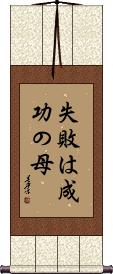
失敗は成功の母 is a Japanese proverb that means exactly what you think.
Every failure that you experience is a chance to learn from it and find success.
Knowing what does not work is just as important as finding out what does work.
Note: This is the Japanese version of an ancient Chinese proverb.
Note: Because this selection contains some special Japanese Hiragana characters, it should be written by a Japanese calligrapher.
See Also: Experience is the Mother of Wisdom
Family / Household
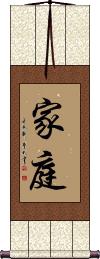
家庭/傢庭 is a common way to express family, household, or home in Chinese, Japanese Kanji, and old Korean Hanja.
However, for a wall scroll, we recommend the single-character form (which is just the first character of this two-character word). If you want that, just click here: Family Single-Character
The first character means “family” or “home.” The second means “courtyard” or “garden.” When combined, the meaning is a bit different, as it becomes “household” or “family.” The home and/or property traditionally has a strong relationship with family in Asia. Some Chinese, Korean, and Japanese families have lived in the same house for 7 or more generations!
Fate / Opportunity / Chance
The Buddhist idea of Fate
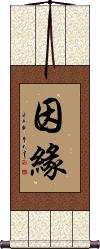
因緣 is the Buddhist concept of a chance meeting or an opportunity that presents itself by fate.
Sometimes this is used to describe a cosmic chain of events or cause and effect.
It also is used to describe predestined relationships between people - and sometimes married couples (although if you want one about marriage, try this: Fate / Destiny of Lovers.
因緣 can also be translated as origin, karma, destiny, affinity, connection, and relation. This all depends on context - seen alone on a wall scroll, this will be read with a “fate/chance” meaning by a Chinese person or a Korean person who can read Hanja.
The more complex definition of this word would be, “Direct causes and indirect conditions, which underlie the actions of all things.”
This concept is known as nidana in the original Sanskrit. Also sometimes presented as hetupratyaya (or “hetu and prataya”), which I believe is Pali.
Note: Japanese will tend to use this version of the second Kanji: 
If you order this from the Japanese master calligrapher, expect that you’ll get this version. However, this word often carries a negative connotation in Japanese (bad things happen), as it is used that way in a certain Japanese idiom. Therefore, this may not be the best choice if Japanese is your target language.
See Also: Buddhism | Opportunity
Five Elements
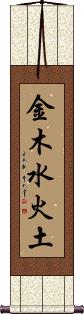
金木水火土 is a list of the Chinese characters for the five elements in a comfortable order (meaning that they “feel right” to a Chinese person who views this arrangement).
The order is metal, wood, water, fire, and earth.
Note that sometimes the metal element is translated as gold. And earth refers to soil versus the whole planet earth.
See Also: Wood | Fire | Water | Earth | Metallica | Five Elements
A Bright Future
Incredible 10,000-Mile Flight of the Peng
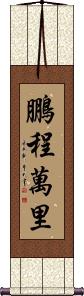
鵬程萬里 is an ancient Chinese proverb used in modern times to wish someone a long and successful career.
It's really about the 10,000 Flight of the Peng (Peng, also known as Roc is a mythical fish that can turn into a bird and take flight).
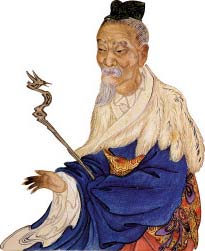
莊子
Zhuangzi or Chuang Tzu
Breaking down each character:
1. Peng or Roc (a kind of bird).
2. Journey (in this case, a flight).
3. 10,000 (Ten Thousand).
4. Li is a unit of distance often referred to as a “Chinese Mile,” though the real distance is about half a kilometer.
Direct Translation: “Peng's Journey [of] 10,000 Li.”
Literal meaning: “The 10,000-Li Flying Range Of The Roc.”
Perceived meaning: “To have a bright future” or “To go far.”
This proverb/idiom comes from the book of Zhuangzi or Chuang Tzu. It tells the tale of a huge fish that could turn into a gigantic bird. This bird was called a “peng” and was many miles long. This legendary size allowed the Peng to fly from the Northern Sea to the Southern Sea in a single bound.
Wishing someone “a Peng's Journey of 10,000 Li” will imply that they can travel far without stopping and will have great success, a long career, and a prosperous future.
Flourish
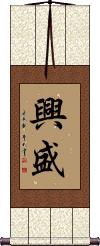
興盛 means to flourish and thrive.
This can also be translated as prosperity, flourishing, thriving, to blossom, prospering, being successful, or achieving success.
Can also be the given name Okimori in Japanese.
Loving Grandfather
Maternal (Northern China)
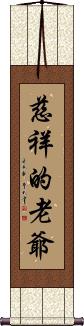
慈祥的老爺 is what you would call your maternal grandfather (mother's father) in Northern China with the adjective/title “Dear” on the front.
Dear Grandfather
Maternal (Northern China)
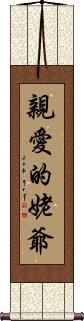
親愛的姥爺 is what you would call your maternal grandfather (mother's father) in Northern China with the adjective/title “Dear” on the front.
Loving Grandfather
Maternal (Southern China)
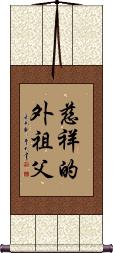
慈祥的外祖父 is “Loving Grandfather” in the formal way that people in Southern China usually call their mother's father (maternal grandfather).
Loving Grandfather
Maternal (Southern China - Informal)
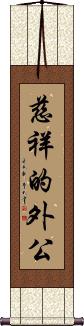
慈祥的外公 is “Loving Grandfather” using an informal way to call your maternal grandfather (mother's father) in Southern China.
Dear Grandfather
Maternal (Southern China)
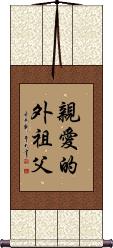
親愛的外祖父 is the formal way that people in Southern China usually call their mother's father (maternal grandfather) with the adjective/title “Dear” on the front.
Dear Grandfather
Maternal (Southern China - Informal)
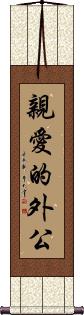
親愛的外公 is an informal way to call your maternal grandfather (mother's father) in Southern China with the adjective/title “Dear” on the front.
Loving Grandmother
Maternal (Northern China)
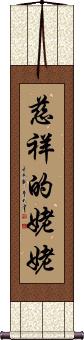
慈祥的姥姥 is “Loving Grandmother” in the common way to refer to your mother's mother (maternal grandmother) in Northern China.
Dear Grandmother
Maternal (Northern China)
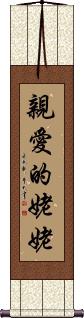
親愛的姥姥 is the common way to refer to your mother's mother (maternal grandmother) in Northern China with the adjective/title “Dear” on the front.
Loving Grandmother
Maternal (Southern China)
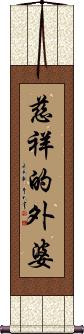
慈祥的外婆 is “Loving Grandmother” in a common way to refer to your mother's mother (maternal grandmother) in Southern China.
Loving Grandmother
Maternal (Southern China - formal)
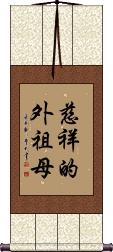
慈祥的外祖母 is “Loving Grandmother” in the formal way to refer to your mother's mother (maternal grandmother) in Southern China.
Dear Grandmother
Maternal (Southern China)
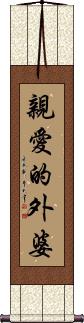
親愛的外婆 is a common way to refer to your mother's mother (maternal grandmother) in Southern China with the adjective/title “Dear” on the front.
Dear Grandmother
Maternal (Southern China - formal)
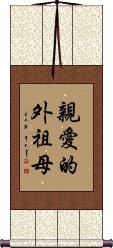
亲爱的外祖母 is the formal way to refer to your mother's mother (maternal grandmother) in Southern China with the adjective/title “Dear” on the front.
Loving Grandmother
Paternal (Northern China)
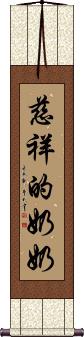
慈祥的奶奶 is “Loving Grandmother” in probably the most common way to refer to your father's mother (paternal grandmother) in northern China.
Dear Grandmother
Paternal (Northern China)
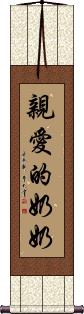
親愛的奶奶 is probably the most common way to refer to your father's mother (paternal grandmother) in northern China with the adjective/title “Dear” on the front.
Loving Grandmother
Paternal (Southern China)
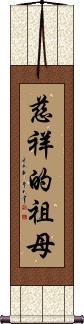
慈祥的祖母 is “Loving Grandmother” in the most common way to refer to your father's mother (paternal grandmother) in Southern China.
Dear Grandmother
Paternal (Southern China)
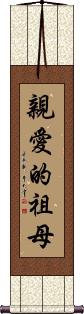
The most common way to refer to your father's mother (paternal grandmother) in Southern China with the adjective/title “Dear” on the front.
Guan Gong / Warrior Saint
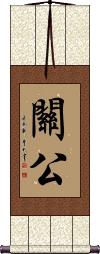
關公 is a Chinese title, Guan Gong, that means Lord Guan (The warrior saint of ancient China).
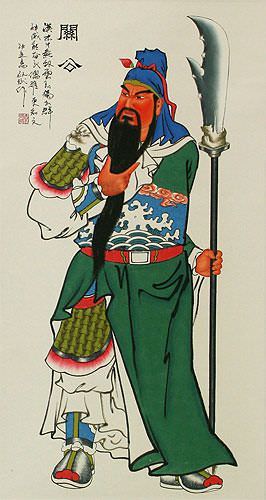 While his real name was Guan Yu / 關羽, he is commonly known by the title of Guan Gong (關公).
Some Chinese soldiers still pray to Guan Gong for protection. They would especially do this before going into battle. Statues of Guan Gong are seen throughout China.
Holy Mother / Saint Mary
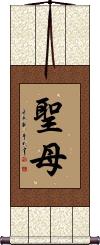
聖母 is the title for the Holy Mother, Madonna, or Virgin Mary used by Catholic Chinese, Korean, and Japanese people.
I think this would be a very cool wall scroll for a devout Catholic who also appreciates Asian artwork and language.
Note: Koreans often put a third character after these two, which creates a title that means “Hail Mary”; however, this character is not added or used in the same way in Japanese or Chinese. If you want that Korean title, just let me know, and we'll add that character for you. The two-character title shown to the left is universal, so I think it's the best choice.
Honor
(Modern Japanese version)
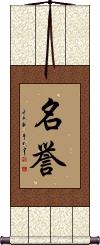
名譽 is a version of honor that is about having or earning the respect of others and about your reputation.
It is the status of being worthy of honor (not to be confused with doing honorable things or specific actions - see our other “honor” listing for that).
 Both modern Japanese and modern mainland Chinese use the same simplified version of the second character of honor. You can make a special request for the traditional second character as shown to the right (just click on that character to the right of you want to order that version). Before WWII, both Japan and China used the traditional form but modern Japanese and Chinese use this simplified form. Koreans still use the traditional form when they are not writing in their modern Hangul glyphs.
This is also a virtue of the Samurai Warrior
See our page with just Code of the Samurai / Bushido here
Even The 100-Foot Bamboo Can Grow One More Foot
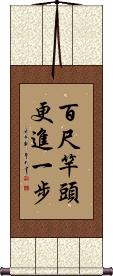
百尺竿头更进一步 is a proverb that literally translates as: [Even a] one-hundred foot [tall] bamboo [can] progress even one [more] step.
Figuratively, this means: After having achieved a fair degree of success, one should try to do still better.
Justice / Rectitude / Right Decision
Also means: honor loyalty morality righteousness
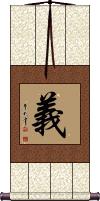
義 is about doing the right thing or making the right decision, not because it's easy but because it's ethically and morally correct.
No matter the outcome or result, one does not lose face if tempering proper justice.
義 can also be defined as righteousness, justice, morality, honor, or “right conduct.” In a more expanded definition, it can mean loyalty to friends, loyalty to the public good, or patriotism. This idea of loyalty and friendship comes from the fact that you will treat those you are loyal to with morality and justice.
義 is also one of the five tenets of Confucius's doctrine.
 There's also an alternate version of this character sometimes seen in Bushido or Korean Taekwondo tenets. It's just the addition of a radical on the left side of the character. If you want this version, click on the image to the right instead of the button above.
This is also a virtue of the Samurai Warrior
See our page with just Code of the Samurai / Bushido here
See Also: Judge | Unselfish: Perfectly Impartial | Ten
Learn From Your Predecessors
When the cart in front overturns, be cautious with your own
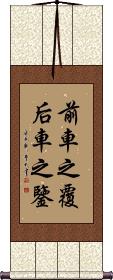
前車之覆后車之鑒 is a Chinese proverb that suggests looking at the circumstances and toils of those you proceeded before you and learning from their experience.
This more literally means “the cart in front overturns, a warning to the following cart.”
This is figuratively translated as “draw a lesson from the failure of one's predecessor,” “learn from past mistakes,” or compared to the English idiom, “once bitten twice shy.”
Other more-direct translations:
Make the overturning of the chariot in front a warning for the chariot behind.
Learn caution through an unpleasant experience.
The wrecked coach in front should be a warning.
The overturned cart in front serves as a warning to the carts behind.
You May Learn from Victory, You Will Learn from Failure
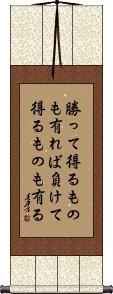
You may learn when everything goes right but the lessons learned when everything goes wrong are more vivid and lead to long-lasting wisdom.
Another way to look at this: One cannot always depend on past successes to guarantee future success but one can always learn from lessons drawn from failure.
Note: Because this selection contains some special Japanese Hiragana characters, it should be written by a Japanese calligrapher.
See Also: Failure is the Mother of Success | Success | Time | Schooled by Experience and Hard Knocks
A Life of Happiness and Prosperity
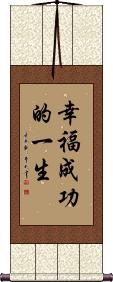
幸福成功的一生 means “A life of happiness and prosperity” or “A life of happiness and success.”
It's a very positive and inspirational wall scroll selection.
See Also: Prosperity
A Life of Happiness and Prosperity
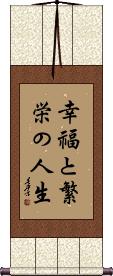
幸福と繁栄の人生 is a Japanese proverb that means “A life of happiness and prosperity” or “A life of happiness and success.”
Note: Because this selection contains some special Japanese Hiragana characters, it should be written by a Japanese calligrapher.
See Also: Prosperity
Life Energy / Spiritual Energy
Chi Energy: Essence of Life / Energy Flow
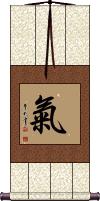
This 氣 energy flow is a fundamental concept of traditional Asian culture.
氣 is romanized as “Qi” or “Chi” in Chinese, “Gi” in Korean, and “Ki” in Japanese.
Chi is believed to be part of everything that exists, as in “life force” or “spiritual energy.” It is most often translated as “energy flow” or literally as “air” or “breath.” Some people will simply translate this as “spirit,” but you must consider the type of spirit we're talking about. I think this is weighted more toward energy than spirit.
The character itself is a representation of steam (or breath) rising from rice. To clarify, the character for rice looks like this: 
Steam was apparently seen as visual evidence of the release of “life energy” when this concept was first developed. The Qi / Chi / Ki character is still used in compound words to mean steam or vapor.
The etymology of this character is a bit complicated. It's suggested that the first form of this character from bronze script (about 2500 years ago) looked like these samples: 

However, it was easy to confuse this with the character for the number three. So the rice radical was added by 221 B.C. (the exact time of this change is debated). This first version with the rice radical looks like this: 
The idea of Qi / Chi / Ki is really a philosophical concept. It's often used to refer to the “flow” of metaphysical energy that sustains living beings. Yet there is much debate that has continued for thousands of years as to whether Qi / Chi / Ki is pure energy or consists partially or fully of matter.
You can also see the character for Qi / Chi / Ki in common compound words such as Tai Chi / Tai Qi, Aikido, Reiki, and Qi Gong / Chi Kung.
In the modern Japanese Kanji, the rice radical has been changed into two strokes that form an X.
 The original and traditional Chinese form is still understood in Japanese, but we can also offer that modern Kanji form in our custom calligraphy. If you want this Japanese Kanji, please click on the character to the right instead of the “Select and Customize” button above.
More language notes: This is pronounced like “chee” in Mandarin Chinese, and like “key” in Japanese.
This is also the same way to write this in Korean Hanja where it is Romanized as “gi” and pronounced like “gee” but with a real G-sound, not a J-sound.
Though Vietnamese no longer use Chinese characters in their daily language, this character is still widely known in Vietnam.
See Also: Supernatural Energy | Life Force | Vitality | Eternal Wheel of Life | Birth Old-Age Sickness Death | Wolf Spirit / Soul of a Wolf
Loving Mother
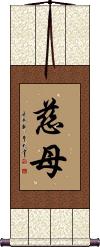
慈母 create the title of a loving mother, affectionate mother, or merciful mother.
A great gift for your mom.
See Also: One Family Under Heaven
Mama / Mother / Mommy
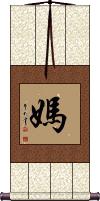
媽 is the oral way that most Chinese people refer to their mothers. Often, they will put this together twice (two of the same character in a row) to create a word that sounds like “Mama.” That's absolutely what little kids call their mothers in China. This Chinese “Mama” is the rough equivalent of “Mommy” in English. Beyond a certain age, Chinese will start to just say “Ma,” which is like saying “Mom.”
This entry is just here for a language lesson. This would make a strange wall scroll by Chinese standards. In Chinese, there are sometimes oral words that don't seem appropriate when written in calligraphy, and this is one of them. See our entry for “Loving Mother” for a better selection.
See Also: Loving Mother | One Family Under Heaven
Mother
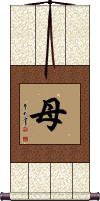
母 is a way to say mother in Chinese, Japanese Kanji, and old Korean Hanja.
This can also be an honorary title for an elderly female relative.
Sometimes this can refer to the origin or source of something. Examples: A spring might be the mother of a river, or experience could be the mother of success.
Mother and Daughter
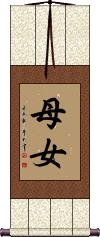
母女 means “mother and daughter” as a unit or as if mother and daughter are a whole together.
母女 is an unusual selection for a calligraphy wall scroll and can be read in many different ways. Your native Asian friends might wonder what you are trying to say. They might even read it as “a mother and daughter without a dad.”
This entry was added to our database for a customer's special request. It has the same meaning in Chinese Characters and Korean Hanja.
See Also: Mother and Son
Mother and Daughter
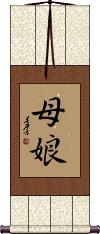
母娘 means “mother and daughter” in Japanese Kanji.
母娘 is an unusual selection for a calligraphy wall scroll and can be read in many different ways. Your native Japanese friends might wonder what you are trying to say.
Note: This will not make sense in Chinese.
See Also: Mother and Son
Love for Parents
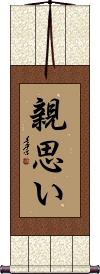
親思い is “love or affection for one's parents” in Japanese.
Mother and Son
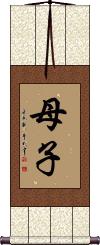
母子 simply means “mother and son,” or the essence of the relationship and bond between mother and son.
母子 is really a single word that expresses this idea (showing how important or significant this bond is).
This is not the most common choice for a wall scroll, it is acceptable if you feel this term is important to you.
See Also: Mother and Daughter
Mother Nature
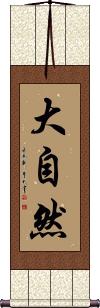
大自然 is the simple way to express “mother nature” in Chinese, Japanese Kanji, and old Korean Hanja.
This can also be translated as “the great nature” or “all of nature.”
A Mother’s Love / Motherly Love
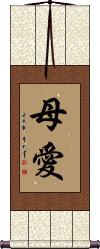
母愛 is a way to write a mother's love or motherly love in Chinese.
Breaking down the characters:
母 means mother.
愛 means love.
Nature in Balance / Balanced Nature
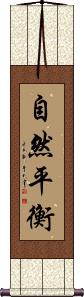
This means “nature balanced.”
The first two characters mean nature (as in mother nature, or all biological life).
The second two characters mean balance or balanced.
Nature in Balance / Balanced Nature
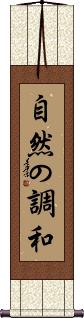
自然の調和 means “nature in harmony” in Japanese.
The first two Kanji mean nature (as in mother nature or the natural world).
The middle Hiragana is a possessive article that connects the two ideas.
The last two Kanji mean “in harmony” or “in balance.”
No arrogance in victory, No despair in defeat
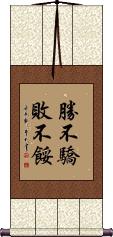
勝不驕敗不餒 is a Chinese proverb suggesting you should have no arrogance when you experience a victory and not despair in failure or defeat.
Do not fear being slow, fear standing still
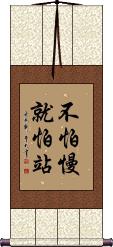
不怕慢就怕站 is a Chinese proverb that translates as: Don't worry about being slow; only worry about standing still.
Figuratively, this means: A slow progress holds some promise but to stand still promises failure.
Opportunity
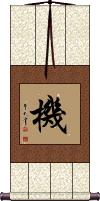
機 is an odd one - I've seen this on coffee cups and posters with the meaning of “opportunity.”
機 is a correct definition but this character also means “machine.” In fact, if you put the character for “flying” in front of this character, you have the Chinese word for “airplane” (literally: flying machine). Alone, on a wall scroll, it will be generally understood as “opportunity” but I want you to know this extra information before you make your selection. Note that in Japanese and Korean, this has a similar meaning but can also mean machine or loom.
See Also: Success
Opportunity
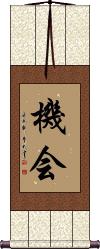
機会 is a common way to express “opportunity” in Japanese.
The first character means “chance,” and the second can mean “meeting.”
So in Japanese business, a “chance meeting” represents a real “opportunity.”
Note that this also means opportunity in Chinese, but it's more an oral or informal word in Mandarin. Also, the second Kanji is the same as the simplified version of the hui Chinese character.
See Also: Success
Opportunity
Opportune Time
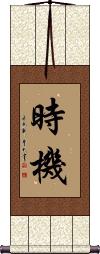
Love Between Child and Parents
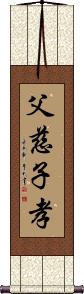
父慈子孝 is a Chinese proverb that means “benevolent father, filial son.”
Figuratively, this is the natural love between parents and children.
Appreciation and Love for Your Parents
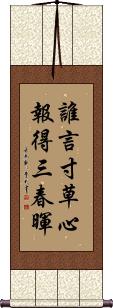
誰言寸草心報得三春暉 is the last line of a famous poem. It is perceived as a tribute or ode to your parents or mother from a child or children that have left home.
The poem was written by Meng Jiao during the Tang Dynasty (about 1200 years ago). The Chinese title is “You Zi Yin” which means “The Traveler's Recite.”
The last line as shown here speaks of the generous and warm spring sunlight which gives the grass far beyond what the little grass can could ever give back (except perhaps by showing its lovely green leaves and flourishing). The metaphor is that the sun is your mother or parents, and you are the grass. Your parents raise you and give you all the love and care you need to prepare you for the world. A debt that you can never repay, nor is repayment expected.
The first part of the poem (not written in the characters to the left) suggests that the thread in a loving mother's hands is the shirt of her traveling offspring. Vigorously sewing while wishing them to come back sooner than they left.
...This part is really hard to translate into English that makes any sense but maybe you get the idea. We are talking about a poem that is so old that many Chinese people would have trouble reading it (as if it was the King James Version of Chinese).
Mantis / Praying Mantis
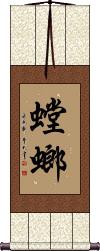
螳螂 is mantis or “praying mantis,” as it's often titled in English.
Technically speaking, this especially applies to the narrow-winged mantis (Tenodera angustipennis)
It is best to use this very common two-character Asian title for the mantis, as the second character alone can mean mantis or dragonfly (totally ambiguous).
This title is antiquated in Japanese, as they tend to write カマキリ (kama kiri) in Katakana to mean praying mantis.
 Note: There is an alternate form of this title which uses the character shown to the right instead of the first character shown above. This is uncommon in both Japan and China (if you really want it anyway, please let us know).
Realize Your Ambitions / Ride on the Crest of Success
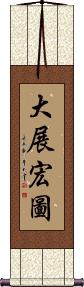
大展宏圖 is a four-character proverb used in Chinese to mean “realize your ambitions” or “exhibit your ambition and success.”
It's used to talk about someone with great career ambitions. Almost literally, it expresses the idea of someone unfolding a great career like a map or a set of blueprint plans.
Very literally translated, these four characters mean “Great unfolding of a huge map” or “Great exhibition of a colossal plan.”
Prosperous Business
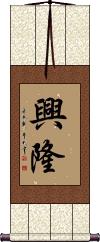
興隆 is a kind of prosperity that applies to a business. Something great to hang behind your desk if you are a small or large business owner. Doing so says that you either are a booming business or you wish success and prosperity for your business.
Can also be translated as thriving, flourishing, brisk business, and other words related to prosperity in business.
A good meaning in China but is a little antiquated in Japanese.
See Also: Prosperity
Reiki
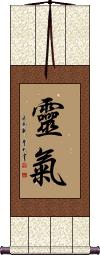
靈氣 is the title of a healing practice now found globally but with origins in Japan.
Special note: Outside of the context of the healing practice of Reiki, this means “aura” or “spiritual essence that surrounds all living things.” A Japanese person unfamiliar with the practice will take the “aura” meaning.
Reiki is a technique for stress reduction and relaxation that also heals. It can be compared to massage but is based on the idea that an unseen “life force energy” flows through us and is what causes us to be alive. If your life force energy is low, you'll be more likely to get sick or feel stressed. If your life force energy is abundant and flowing well, you become more capable of being happy and healthy.
There is many information available if you want to Google this term - my job is to offer the calligraphy while you can decide if it is right for you.

Note: We are showing the ancient (traditional) form of the Reiki Kanji. I have seen Reiki written with the slightly simplified version and this more classic form. If you want the form of Reiki with the two strokes in the shape of an X on the second character and the modern first character, simply click on the Kanji characters to the right.
Note: 靈氣 is also a Chinese word, but in Chinese, these characters create a word that refers to a smart person or someone with high aspirations. It is not read as a healing method in Chinese.
In Korean Hanja, this can be read as a “mysterious atmosphere” by a Korean who is not familiar with the practice of Reiki (still has a cool meaning in Korean).
Respect
Politeness, Gratitude and Propriety
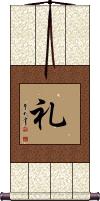
礼 is one of the five tenets of Confucius.
Beyond respect, 礼 can also be translated as propriety, good manners, politeness, rite, worship, or an expression of gratitude.
We show respect by speaking and acting with courtesy. We treat others with dignity and honor the rules of our family, school, and nation. Respect yourself, and others will respect you.
 Please note that Japanese use this simplified 礼 version of the original 禮 character for respect. 礼 also happens to be the same simplification used in mainland China. While 禮 is the traditional and original version, 礼 has been used as a shorthand version for many centuries. Click on the big 禮 character to the right if you want the Traditional Chinese and older Japanese versions.
This is also a virtue of the Samurai Warrior
See our page with just Code of the Samurai / Bushido here
See Also: Confucius
Not Only Can Water Float A Boat, It Can Sink It Also
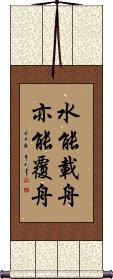
Many things have opposite properties. The water you drink can also drown you. Pork may nourish you and keep you alive but under-cook it and it could kill you. Potassium nitrate is often used as a fertilizer to grow the food that sustains us but it's also been used as an explosive to topple buildings and destroy us.
This concept is easily associated with “yin yang” where an element has two opposite properties that are as different as night and day.
This proverb's meaning can be summed up this way: “Anything that can lead you to success may also contain great risks.”
This phrase is known in literary circles by Korean people (scholars or literature). It is therefore also a valid proverb in Korean Hanja, though most Koreans would not be able to make sense of it.
Please note that there is an unwritten rule when the same character appears twice in the same phrase, the calligrapher will alter the appearance so that no two characters are exactly alike in the same piece. This calligraphy has two repeating characters that will be written differently than they appear here.
Perseverance is the Key
Skills cannot be perfected without perseverance in practice
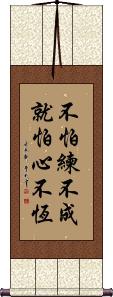
不怕练不成就怕心不恒 literally translates as: Do not worry about not being able to master [a skill]; What [one should] be concerned about is lack of perseverance.
Figuratively, this means: One's skills cannot be perfected without perseverance in practice.
For me, I've learned that you can only get so much from school or studying. You've really got to do “on-the-job training” to perfect your ability and skill.
For martial arts students: You can read about a kick in a book, or someone can tell you about a certain kick but until you practice the kick, there's no way you'll master it.
Japanese Snapping Turtle / Chinese Soft Shell Turtle
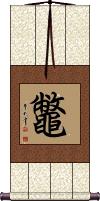
鼈 refers to a species of turtle.
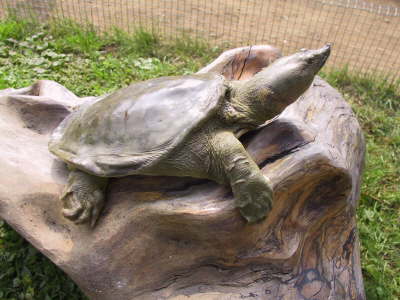
鼈 is Trionyx Sinensis.
鼈 refers to different turtles in different languages. See individual language notes below:
Japanese: 鼈 means “snapping turtle” or “mud turtle.” But rarely used as a single Kanji like this in Japanese.
Chinese: 鼈 means soft-shelled turtle. A specific species, Trionyx Sinensis is native to Asia.
In China, this species is related to the “wang ba,” a soft-shelled turtle sometimes known in English as a banjo turtle (due to its long neck, and general shape). Unfortunately, there is a word, “wang ba dan” which means the egg of this species of turtle. That term has come to mean “bastard” in Chinese (a turtle hatches from an abandoned egg, and does not know who his mother or father is). 鼈 is not a good selection for a wall scroll if your audience is Chinese.
In Korean, this character can be pronounced (though most Koreans would have to look it up in a dictionary). It has not been in common use in Korea for at least a few hundred years.
General notes: You may notice that the bottom half of this character is the same as some other turtle-related titles. That bottom half is actually an ancient character that means “toad.”  Though not seen in this way today, most turtle-related characters hold the meaning of “a toad with a shell” in their ancient origin. That toad character is rarely used alone anymore but you can see what it looks like in the image to the right.
Success
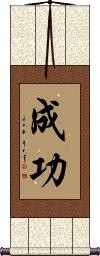
This Chinese and Japanese word for “success” is often used to refer to “career success” but is also used for other successes in life.
It matches the western dictionary definition of “The achievement of something desired, planned, or attempted.” And It's also used in this old Chinese proverb:  which means Failure is the Mother of Success.
Sometimes this word is translated as prosperity, but success, succeed, or successfully are more correct definitions.
See Also: Prosperity
Failure is a Stepping Stone to Success
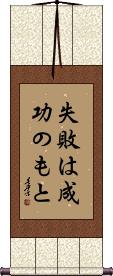
This Japanese proverb literally reads, “failures/mistakes/blunders are the yeast-starter/yeast-mash of success.”
it suggests that failures are a necessary part of success; Just as bread or beer requires yeast to successfully rise or brew/ferment.
Note: Because this selection contains some special Japanese Hiragana characters, it should be written by a Japanese calligrapher.
The More We Sweat in Training, The Less We Bleed in Battle
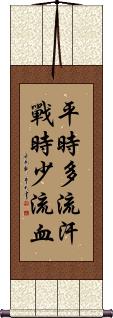
There is more than one way to translate the ancient Chinese military proverb, 平时多流汗战时少流血. Here are a few interpretations:
A drop of sweat spent in a drill is a drop of blood saved in war.
More practice will give one a better chance of success in real situations.
The more you sweat in training, the less you bleed in battle.
I heard this many times when I was a U.S. Marine but I had no idea at the time that it was actually an old Chinese proverb.
See Also: Blood Sweat and Tears
Sword
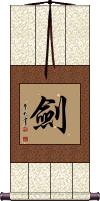
劍 is pronounced “jian” in Chinese. When you say it, imagine that you are making the sound of a sword as it clashes with a metal shield. This might get you closer to the correct pronunciation in Chinese.
I actually wonder if this word came from the metallic ringing sounds of a sword in battle - but such knowledge is lost in history.
The sword is a symbol of a warrior. The one thing that a soldier in ancient China lived and died by. A warrior with his skills and sword proves himself of great value. A warrior who losses his sword instantly becomes worthless.
劍 is an excellent scroll for someone in the military (especially officers of all services - as well as enlisted NCO Marines since they still carry swords even if mainly for ceremonial purposes). Or perhaps someone who practices variations of kung fu or tai chi that involve weapons.
Please note that while this character is understood with the sword meaning in Japanese, you might be looking for the word “katana” which also means sword in Japanese but means “knife” in Chinese.
There are other ways to write sword, and here are a few...


If you are particular about the version you receive, please let me know when you place your order (Note: Special styles are only available from one of our master calligraphers).
See Also: Katana
Taekwondo
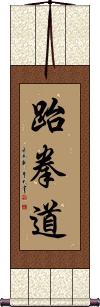
跆拳道 is one of the most widespread types of martial arts in the world as well as being an Olympic sport. Taekwondo was born in Korea with influences of Chinese and Japanese styles combined with traditional Korean combat skills. Some will define it as the “Korean art of empty-handed self-defense.”
In the simplest translation, the first character means “kick,” the second character can mean either “fist” or “punching,” and the third means “way” or “method.” Altogether, you could say this is the “Kick Punch Method.” When heard or read in various Asian languages, all will automatically think of this famous Korean martial art. It is written the same in Japanese Kanji, Chinese, and Korean Hanja characters - so the appearance of the characters is universal. However, you should note that there is another way to write this in modern Korean Hangul characters, which looks like the image to the right. 
We suggest the original Korean Hanja (Chinese characters) for a wall scroll, but if you need the Hangul version, you must use master calligrapher Cao Bin: Order Taekwondo in Korean Hangul
Note: Taekwondo is sometimes Romanized as Tae-Kwondo, Tae Kwon Do, Taekwon-do, Taegwondo, Tae Gweon Do, Tai Kwon Do, Taikwondo, Taekwando, Tae Kwan Do and in Chinese Taiquandao, Tai Quan Dao, Taichuando, or Tai Chuan Tao.
Take Up a Challenge
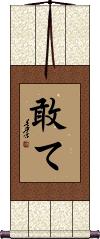
敢て is a Japanese word that can mean a few things related to the idea of taking up a challenge.
It can mean daring (to do something), venturing (often overcoming reluctance), or taking action (even in the face of probable failure). It can also be to take upon oneself or take up a challenge.
Turtle
...also means tortoise
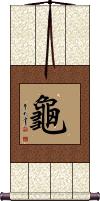
龜 is the generic term for turtle in Chinese and old Korean Hanja. It's like saying “turtle” (or “tortoise”) without being specific about the species of turtle.
Please note that there are many special characters in Chinese and a few in Japanese that denote specific species of turtle and do not include this character. We can't possibly cover all of these species, but if you want a certain one, such as “loggerhead” or a “leatherback,” just contact me, and I'll do my best to research your special species.
If you noticed, I said species names that do not include this character. This is because, in much the same way we can do it in English by just saying, “loggerhead” instead of “loggerhead turtle,” the same can be done in Chinese and Japanese.
 This may be hard to believe, but the image shown to the right is an alternate version of this character, which is currently used in Japan. This was originally an alternate form in ancient China for turtle - but it's so obscure now that most Chinese people would just think this is the Japanese version of turtle (I did many research on this). The version shown in the upper left is traditional Chinese (also used in Korea 100+ years ago). It will generally not be recognized by the new generation of Japanese people. If your audience is Japanese, please click on the Kanji image shown to the right to have the calligrapher write that version (instead of clicking the button above).
Note: In Japanese, this Kanji is also a representation of long life. This is related to the fact that a tortoise can live for hundreds of years.
Win / Victory
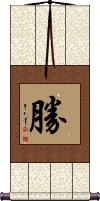
勝 is a single character that means to win or be victorious.
This can also be translated: To overcome; success; to beat; to defeat; to surpass; superior to; to get the better of; better than; surpassing; superb.
In another context, this can mean beautiful (scenery); scenic spot; or scenic beauty.
In Taiwanese Mandarin, this can be pronounced with the first tone (sheng1) and mean: Able to bear; equal to (a task).
In Japan, this can also be the name Masaru.
In Korea, this has the same meaning but can also be the surname Sŭng.
Each Time You Stumble and Fall, You Gain Experience and Wisdom
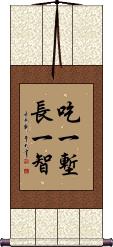
吃一塹長一智 is a Chinese proverb that means “Fall into a moat, and you will gain wisdom from the experience.”
It really suggests that the failures, troubles, frustrations, and setbacks that you encounter in your life are actually helping you to find wisdom. Some would also translate this proverb as “Learn from your mistakes” or “Learn from your experience.”
If you are studying Chinese, you will recognize the first character as “eat,” but in this case, it means to “experience” (as used in this proverb, it is suggesting that you have fallen into a moat and/or had a hard time crossing it).
Translated character by character, this whole proverb is, “Experience one moat, gain one wisdom/knowledge.”
Note: This can be pronounced in Korean, but it's not a commonly used phrase.
Wolf
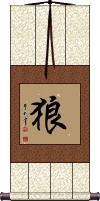
狼 is the character used to represent the elusive animal known as the wolf in both Chinese and Japanese.
If you are a fan of the wolf or the wolf means something special to you, this could make a great addition to your wall.
Do keep in mind, that much like our perception of wolves in the history of western culture, eastern cultures do not have a very positive view of wolves (save the scientific community and animal lovers). The wolf is clearly an animal that is misunderstood or feared the world over.
狼 is seldom used alone in Korean Hanja but is used in a compound word that means utter failure (as in a wolf getting into your chicken pen - or an otherwise ferocious failure). Not a good choice if your audience is Korean.
Zen / Chan / Meditation
...as in Zen Buddhism
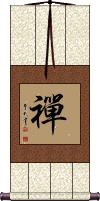
First, let's correct something: The Japanese romanization for this character, “Zen” has penetrated the English language. In English, it's almost always incorrectly used for phrases like “That's so zen.” Nobody says, “That's so meditation” - right? As the title of a sect, this would be like saying, “That's so Baptist!”
禪 by itself just means “meditation.” In that context, it should not be confined to use by any one religion or sect.
Regardless of the dictionary definition, more often than not, this character is associated with Buddhism. And here is one of the main reasons:
Zen is used as the title of a branch of Mahayana Buddhism, which strongly emphasizes meditation practice.
However, it should be noted that Buddhism came from India, and “Chan Buddhism” evolved and developed in medieval China. The Chinese character “Chan” was eventually pronounced as “Zen” in Japanese. Chan Buddhists in China have much in common with Zen Buddhists in Japan.
More about the history of Zen Buddhism here.
Please also note that the Japanese Kanji character for Zen has evolved a little in Japan, and the two boxes (kou) that you see at the top of the right side of the character have been replaced by three dots with tails.
 The original character would still be generally understood and recognized in Japanese (it's considered an ancient version in Japan) but if you want the specifically modern Japanese version, please click on the zen Kanji to the right. Technically, there is no difference between the Tensho and Reisho versions of Zen since they are ancient character styles that existed long before Japan had a written language.
 There is also an alternate/shorthand/simplified Chinese version, which has two dots or tails above the right-side radical. This version is also popular for calligraphy in China. If you want this version, just click the character to the right.
Further notes: Zen is just one of seven sects of Buddhism practiced in Japan. The others are 律 Ritsu (or Risshū), 法相 Hossō, 論 Sanron 華嚴 Kegon, 天台 Tendai, and 眞言 Shingon.
This in-stock artwork might be what you are looking for, and ships right away...


The following table may be helpful for those studying Chinese or Japanese:
| Title | Characters | Romaji (Romanized Japanese) | Various forms of Romanized Chinese | |
| 1. Right Understanding Right Perspective Right View Perfect View | 正見 正见 | sei ken / seiken | zhèng jiàn zheng4 jian4 zheng jian zhengjian | cheng chien chengchien |
| Even a fool may sometimes come up with a good idea | 千慮一得 千虑一得 | senryonoittoku | qiān lǜ yī dé qian1 lv4 yi1 de2 qian lv yi de qianlvyide | ch`ien lü i te chienlüite chien lü i te |
| Eight Black Horses | 黑八馬 黑八马 | hēi bā mǎ hei1 ba1 ma3 hei ba ma heibama | hei pa ma heipama |
|
| Achievement Accomplishment | 成就 | jouju / joju | chéng jiù cheng2 jiu4 cheng jiu chengjiu | ch`eng chiu chengchiu cheng chiu |
| Always Try to do Better | 更に上を目指す | sara ni ue o me za su saraniueomezasu | ||
| Any success cannot compensate for failure in the home | 所有的成功都無法補償家庭的失敗 所有的成功都无法补偿家庭的失败 | suǒ yǒu de chéng gōng dōu wú fǎ bǔ cháng jiā tíng de shī bài suo3 you3 de cheng2 gong1 dou1 wu2 fa3 bu3 chang2 jia1 ting2 de shi1 bai4 suo you de cheng gong dou wu fa bu chang jia ting de shi bai | so yu te ch`eng kung tou wu fa pu ch`ang chia t`ing te shih pai so yu te cheng kung tou wu fa pu chang chia ting te shih pai |
|
| No man knows what he owes to his parents until he comes to have children of his own | 子を持って知る親の恩 | ko wo motte shiru oya no on kowomotteshiruoyanoon | ||
| Armor | 鎧 铠 | yoroi | kǎi / kai3 / kai | k`ai / kai |
| Wisdom from Hard Knocks | 挨一拳得一招挨十拳變諸葛 挨一拳得一招挨十拳变诸葛 | ái yī quán dé yī zhāo ái shí quán biàn zhū gě ai2 yi1 quan2 de2 yi1 zhao1 ai2 shi2 quan2 bian4 zhu1 ge3 ai yi quan de yi zhao ai shi quan bian zhu ge | ai i ch`üan te i chao ai shih ch`üan pien chu ko ai i chüan te i chao ai shih chüan pien chu ko |
|
| Without a big net, how can you catch fish? | 不撒大網不得大魚 不撒大网不得大鱼 | bù sā dà wǎng bù dé dà yú bu4 sa1 da4 wang3 bu4 de2 da4 yu2 bu sa da wang bu de da yu busadawangbudedayu | pu sa ta wang pu te ta yü pusatawangputetayü |
|
| Bond | 絆 绊 | kizuna | bàn / ban4 / ban | pan |
| Bounce Back Stage a Comeback | 東山再起 东山再起 | dōng shān zài qǐ dong1 shan1 zai4 qi3 dong shan zai qi dongshanzaiqi | tung shan tsai ch`i tungshantsaichi tung shan tsai chi |
|
| You May Learn from Victory, You Will Learn from Failure | 百勝難慮敵三折乃良醫 百胜难虑敌三折乃良医 | bǎi shèng nán lǜ dí sān zhé nǎi liáng yī bai3 sheng4 nan2 lv4 di2 san1 zhe2 nai3 liang2 yi1 bai sheng nan lv di san zhe nai liang yi | pai sheng nan lü ti san che nai liang i | |
| Confucius: Golden Rule Ethic of Reciprocity | 己所不欲勿施於人 己所不欲勿施于人 | jǐ suǒ bú yù wù shī yú rén ji3 suo3 bu2 yu4, wu4 shi1 yu2 ren2 ji suo bu yu, wu shi yu ren jisuobuyu,wushiyuren | chi so pu yü, wu shih yü jen chisopuyü,wushihyüjen |
|
| Determination to Achieve | 一念発起 | ichi nen ho kki ichinenhokki ichi nen ho ki | ||
| Diligence | 勤勉 | kinben | qín miǎn / qin2 mian3 / qin mian / qinmian | ch`in mien / chinmien / chin mien |
| Doctor | 醫生 医生 | yī shēng / yi1 sheng1 / yi sheng / yisheng | i sheng / isheng | |
| Do not fear the task: Cooperation will lead to success | 不怕風浪大就怕槳不齊 不怕风浪大就怕桨不齐 | bù pà fēng làng dà jiù pà jiǎng bù qí bu4 pa4 feng1 lang4 da4 jiu4 pa4 jiang3 bu4 qi2 bu pa feng lang da jiu pa jiang bu qi | pu p`a feng lang ta chiu p`a chiang pu ch`i pu pa feng lang ta chiu pa chiang pu chi |
|
| The Spirit of the Dragon Horse | 龍馬精神 龙马精神 | lóng mǎ jīng shén long2 ma3 jing1 shen2 long ma jing shen longmajingshen | lung ma ching shen lungmachingshen |
|
| The Spirit of the Dragon Horse and Power of a Tiger | 龍馬精神虎虎生威 龙马精神虎虎生威 | lóng mǎ jīng shén hǔ hǔ shēng wēi long2 ma3 jing1 shen2 hu3 hu3 sheng1 wei1 long ma jing shen hu hu sheng wei | lung ma ching shen hu hu sheng wei | |
| Dream Come True Enjoy Success | 得誌 得志 | dé zhì / de2 zhi4 / de zhi / dezhi | te chih / techih | |
| Dripping Water Penetrates Stone | 滴水穿石 | dī shuǐ chuān shí di1 shui3 chuan1 shi2 di shui chuan shi dishuichuanshi | ti shui ch`uan shih tishuichuanshih ti shui chuan shih |
|
| Eagle Claw Overturning Fist | 鷹爪翻子拳 鹰爪翻子拳 | yīng zhuǎ fān zi quán ying1 zhua3 fan1 zi5 quan2 ying zhua fan zi quan yingzhuafanziquan | ying chua fan tzu ch`üan yingchuafantzuchüan ying chua fan tzu chüan |
|
| Let Us Try | 嘗試 尝试 | cháng shì chang2 shi4 chang shi changshi | ch`ang shih changshih chang shih |
|
| Eternal Love | 永恆的愛 永恒的爱 | yǒng héng de ài yong3 heng2 de ai4 yong heng de ai yonghengdeai | yung heng te ai yunghengteai |
|
| Eternal Love | 永遠の愛 | ei en no ai eiennoai | ||
| Experience is the Mother of Wisdom | 經驗是智慧之母 经验是智慧之母 | jīng yàn shì zhì huì zhī mǔ jing1 yan4 shi4 zhi4 hui4 zhi1 mu3 jing yan shi zhi hui zhi mu jingyanshizhihuizhimu | ching yen shih chih hui chih mu | |
| Failure in Not an Option | 失敗並非一種選擇 失败并非一种选择 | shī bài bìng fēi yì zhǒng xuǎn zé shi1 bai4 bing4 fei1 yi4 zhong3 xuan3 ze2 shi bai bing fei yi zhong xuan ze | shih pai ping fei i chung hsüan tse | |
| Failure is Not an Option | 失敗は許されません | shippai wa yurusa remasearimasen shipai wa yurusa remasearimasen | ||
| Failure is the Origin of Success | 失敗は成功の元 | shippai wa seikou no moto shippaiwaseikounomoto shipai wa seiko no moto | ||
| Failure is the Mother of Success | 失敗是成功之母 失败是成功之母 | shī bài shì chéng gōng zhī mǔ shi1 bai4 shi4 cheng2 gong1 zhi1 mu3 shi bai shi cheng gong zhi mu shibaishichenggongzhimu | shih pai shih ch`eng kung chih mu shih pai shih cheng kung chih mu |
|
| Failure is the Mother of Success | 失敗は成功の母 | shippai wa seikou no haha shippaiwaseikounohaha shipai wa seiko no haha | ||
| Family Household | 家庭 / 傢庭 家庭 | ka tei / katei | jiā tíng / jia1 ting2 / jia ting / jiating | chia t`ing / chiating / chia ting |
| Fate Opportunity Chance | 因緣 因缘 / 因縁 | in nen / innen | yīn yuán / yin1 yuan2 / yin yuan / yinyuan | yin yüan / yinyüan |
| Five Elements | 金木水火土 | jīn mù shuǐ huǒ tǔ jin1 mu4 shui3 huo3 tu3 jin mu shui huo tu jinmushuihuotu | chin mu shui huo t`u chinmushuihuotu chin mu shui huo tu |
|
| A Bright Future | 鵬程萬里 鹏程万里 | péng chéng wàn lǐ peng2 cheng2 wan4 li3 peng cheng wan li pengchengwanli | p`eng ch`eng wan li pengchengwanli peng cheng wan li |
|
| Flourish | 興盛 兴盛 | kou sei / kousei / ko sei | xīng shèng xing1 sheng4 xing sheng xingsheng | hsing sheng hsingsheng |
| Loving Grandfather | 慈祥的老爺 慈祥的老爷 | cí xiáng de lǎo ye ci2 xiang2 de lao3 ye ci xiang de lao ye cixiangdelaoye | tz`u hsiang te lao yeh tzuhsiangtelaoyeh tzu hsiang te lao yeh |
|
| Dear Grandfather | 親愛的姥爺 亲爱的姥爷 | qín ài de lǎo ye qin2 ai4 de lao3 ye qin ai de lao ye qinaidelaoye | ch`in ai te lao yeh chinaitelaoyeh chin ai te lao yeh |
|
| Loving Grandfather | 慈祥的外祖父 | cí xiáng de wài zǔ fù ci2 xiang2 de wai4 zu3 fu4 ci xiang de wai zu fu cixiangdewaizufu | tz`u hsiang te wai tsu fu tzuhsiangtewaitsufu tzu hsiang te wai tsu fu |
|
| Loving Grandfather | 慈祥的外公 | cí xiáng de wài gōng ci2 xiang2 de wai4 gong1 ci xiang de wai gong cixiangdewaigong | tz`u hsiang te wai kung tzuhsiangtewaikung tzu hsiang te wai kung |
|
| Dear Grandfather | 親愛的外祖父 亲爱的外祖父 | qín ài de wài zǔ fù qin2 ai4 de wai4 zu3 fu4 qin ai de wai zu fu qinaidewaizufu | ch`in ai te wai tsu fu chinaitewaitsufu chin ai te wai tsu fu |
|
| Dear Grandfather | 親愛的外公 亲爱的外公 | qín ài de wài gōng qin2 ai4 de wai4 gong1 qin ai de wai gong qinaidewaigong | ch`in ai te wai kung chinaitewaikung chin ai te wai kung |
|
| Loving Grandmother | 慈祥的姥姥 | cí xiáng de lǎo lao ci2 xiang2 de lao3 lao ci xiang de lao lao cixiangdelaolao | tz`u hsiang te lao lao tzuhsiangtelaolao tzu hsiang te lao lao |
|
| Dear Grandmother | 親愛的姥姥 亲爱的姥姥 | qín ài de lǎo lao qin2 ai4 de lao3 lao qin ai de lao lao qinaidelaolao | ch`in ai te lao lao chinaitelaolao chin ai te lao lao |
|
| Loving Grandmother | 慈祥的外婆 | cí xiáng de wài pó ci2 xiang2 de wai4 po2 ci xiang de wai po cixiangdewaipo | tz`u hsiang te wai p`o tzuhsiangtewaipo tzu hsiang te wai po |
|
| Loving Grandmother | 慈祥的外祖母 | cí xiáng de wài zǔ mǔ ci2 xiang2 de wai4 zu3 mu3 ci xiang de wai zu mu cixiangdewaizumu | tz`u hsiang te wai tsu mu tzuhsiangtewaitsumu tzu hsiang te wai tsu mu |
|
| Dear Grandmother | 親愛的外婆 亲爱的外婆 | qín ài de wài pó qin2 ai4 de wai4 po2 qin ai de wai po qinaidewaipo | ch`in ai te wai p`o chinaitewaipo chin ai te wai po |
|
| Dear Grandmother | 親愛的外祖母 亲爱的外祖母 | qín ài de wài zǔ mǔ qin2 ai4 de wai4 zu3 mu3 qin ai de wai zu mu qinaidewaizumu | ch`in ai te wai tsu mu chinaitewaitsumu chin ai te wai tsu mu |
|
| Loving Grandmother | 慈祥的奶奶 | cí xiáng de nǎi nai ci2 xiang2 de nai3 nai ci xiang de nai nai cixiangdenainai | tz`u hsiang te nai nai tzuhsiangtenainai tzu hsiang te nai nai |
|
| Dear Grandmother | 親愛的奶奶 亲爱的奶奶 | qín ài de nǎi nai qin2 ai4 de nai3 nai qin ai de nai nai qinaidenainai | ch`in ai te nai nai chinaitenainai chin ai te nai nai |
|
| Loving Grandmother | 慈祥的祖母 | cí xiáng de zǔ mǔ ci2 xiang2 de zu3 mu3 ci xiang de zu mu cixiangdezumu | tz`u hsiang te tsu mu tzuhsiangtetsumu tzu hsiang te tsu mu |
|
| Dear Grandmother | 親愛的祖母 亲爱的祖母 | qín ài de zǔ mǔ qin2 ai4 de zu3 mu3 qin ai de zu mu qinaidezumu | ch`in ai te tsu mu chinaitetsumu chin ai te tsu mu |
|
| Guan Gong Warrior Saint | 關公 关公 | guān gōng guan1 gong1 guan gong guangong | kuan kung kuankung |
|
| Holy Mother Saint Mary | 聖母 圣母 | seibo | shèng mǔ / sheng4 mu3 / sheng mu / shengmu | |
| Honor | 名譽 名誉 | meiyo | míng yù / ming2 yu4 / ming yu / mingyu | ming yü / mingyü |
| Even The 100-Foot Bamboo Can Grow One More Foot | 百尺竿頭更進一步 百尺竿头更进一步 | bǎi chǐ gān tóu gèng jìng yī bù bai3 chi3 gan1 tou2 geng4 jing4 yi1 bu4 bai chi gan tou geng jing yi bu baichigantougengjingyibu | pai ch`ih kan t`ou keng ching i pu pai chih kan tou keng ching i pu |
|
| Justice Rectitude Right Decision | 義 义 | gi | yì / yi4 / yi | i |
| Learn From Your Predecessors | 前車之覆后車之鑒 前车之覆后车之鉴 | qián chē zhī fù hòu chē zhī jiàn qian2 che1 zhi1 fu4 hou4 che1 zhi1 jian4 qian che zhi fu hou che zhi jian | ch`ien ch`e chih fu hou ch`e chih chien chien che chih fu hou che chih chien |
|
| You May Learn from Victory, You Will Learn from Failure | 勝って得るものも有れば負けて得るものも有る | katte erumono mo areba makete erumono mo aru | ||
| A Life of Happiness and Prosperity | 幸福成功的一生 | xìng fú chéng gōng de yì shēng xing4 fu2 cheng2 gong1 de yi4 sheng1 xing fu cheng gong de yi sheng xingfuchenggongdeyisheng | hsing fu ch`eng kung te i sheng hsingfuchengkungteisheng hsing fu cheng kung te i sheng |
|
| A Life of Happiness and Prosperity | 幸福と繁栄の人生 | kou fuku to ha nei no jin sei koufukutohaneinojinsei ko fuku to ha nei no jin sei | ||
| Life Energy Spiritual Energy | 氣 气 / 気 | ki | qì / qi4 / qi | ch`i / chi |
| Loving Mother | 慈母 | ji bo / jibo | cí mǔ / ci2 mu3 / ci mu / cimu | tz`u mu / tzumu / tzu mu |
| Mama Mother Mommy | 媽 妈 | mā / ma1 / ma | ||
| Mother | 母 | haha | mǔ / mu3 / mu | |
| Mother and Daughter | 母女 | mǔ nǚ / mu3 nv3 / mu nv / munv | mu nü / munü | |
| Mother and Daughter | 母娘 | haha musume hahamusume | ||
| Love for Parents | 親思い | oya omoi / oyaomoi | ||
| Mother and Son | 母子 | bo shi / boshi | mǔ zǐ / mu3 zi3 / mu zi / muzi | mu tzu / mutzu |
| Mother Nature | 大自然 | dai shi zen daishizen | dà zì rán da4 zi4 ran2 da zi ran daziran | ta tzu jan tatzujan |
| A Mother’s Love Motherly Love | 母愛 母爱 | mǔ ài / mu3 ai4 / mu ai / muai | ||
| Nature in Balance Balanced Nature | 自然平衡 | zì rán píng héng zi4 ran2 ping2 heng2 zi ran ping heng ziranpingheng | tzu jan p`ing heng tzujanpingheng tzu jan ping heng |
|
| Nature in Balance Balanced Nature | 自然の調和 | shizen no cho wa shizennochowa | ||
| No arrogance in victory, No despair in defeat | 勝不驕敗不餒 胜不骄败不馁 | shèng bù jiāo bài bù něi sheng4 bu4 jiao1 bai4 bu4 nei3 sheng bu jiao bai bu nei shengbujiaobaibunei | sheng pu chiao pai pu nei shengpuchiaopaipunei |
|
| Do not fear being slow, fear standing still | 不怕慢就怕站 | bú pà màn jiù pà zhàn bu2 pa4 man4 jiu4 pa4 zhan4 bu pa man jiu pa zhan bupamanjiupazhan | pu p`a man chiu p`a chan pupamanchiupachan pu pa man chiu pa chan |
|
| Opportunity | 機 机 | hata | jī / ji1 / ji | chi |
| Opportunity | 機會 机会 | kikai | jī huì / ji1 hui4 / ji hui / jihui | chi hui / chihui |
| Opportunity | 時機 时机 | shí jī / shi2 ji1 / shi ji / shiji | shih chi / shihchi | |
| Love Between Child and Parents | 父慈子孝 | fù cí zǐ xiào fu4 ci2 zi3 xiao4 fu ci zi xiao fucizixiao | fu tz`u tzu hsiao futzutzuhsiao fu tzu tzu hsiao |
|
| Appreciation and Love for Your Parents | 誰言寸草心報得三春暉 谁言寸草心报得三春晖 | shuí yán cùn cǎo xīn bào dé sān chūn huī shui2 yan2 cun4 cao3 xin1 bao4 de2 san1 chun1 hui1 shui yan cun cao xin bao de san chun hui | shui yen ts`un ts`ao hsin pao te san ch`un hui shui yen tsun tsao hsin pao te san chun hui |
|
| Mantis Praying Mantis | 螳螂 / 蟷螂 螳螂 | tou rou / tourou / to ro | táng láng tang2 lang2 tang lang tanglang | t`ang lang tanglang tang lang |
| Realize Your Ambitions Ride on the Crest of Success | 大展宏圖 大展宏图 | dà jiǎn hóng tú da4 jian3 hong2 tu2 da jian hong tu dajianhongtu | ta chien hung t`u tachienhungtu ta chien hung tu |
|
| Prosperous Business | 興隆 兴隆 | kou ryuu / kouryuu / ko ryu | xīng lóng xing1 long2 xing long xinglong | hsing lung hsinglung |
| Reiki | 靈氣 灵气 霊気 | reiki | líng qì / ling2 qi4 / ling qi / lingqi | ling ch`i / lingchi / ling chi |
| Respect | 禮 礼 | rei | lǐ / li3 / li | |
| Not Only Can Water Float A Boat, It Can Sink It Also | 水能載舟亦能覆舟 水能载舟亦能覆舟 | shuǐ néng zài zhōu yì néng fù zhōu shui3 neng2 zai4 zhou1 yi4 neng2 fu4 zhou1 shui neng zai zhou yi neng fu zhou | shui neng tsai chou i neng fu chou | |
| Perseverance is the Key | 不怕練不成就怕心不恆 不怕练不成就怕心不恒 | bú pà liàn bù chéng jiù pà xīn bù héng bu2 pa4 lian4 bu4 cheng2 jiu4 pa4 xin1 bu4 heng2 bu pa lian bu cheng jiu pa xin bu heng | pu p`a lien pu ch`eng chiu p`a hsin pu heng pu pa lien pu cheng chiu pa hsin pu heng |
|
| Japanese Snapping Turtle Chinese Soft Shell Turtle | 鼈 | suppon / supon | biē / bie1 / bie | pieh |
| Success | 成功 | seikou / seiko | chéng gōng cheng2 gong1 cheng gong chenggong | ch`eng kung chengkung cheng kung |
| Failure is a Stepping Stone to Success | 失敗は成功のもと | sittpai wa seikou no moto sittpaiwaseikounomoto sittpai wa seiko no moto | ||
| The More We Sweat in Training, The Less We Bleed in Battle | 平時多流汗戰時少流血 平时多流汗战时少流血 | píng shí duō liú hàn zhàn shí shǎo liú xuè ping2 shi2 duo1 liu2 han4 zhan4 shi2 shao3 liu2 xue4 ping shi duo liu han zhan shi shao liu xue | p`ing shih to liu shih shao liu hsüeh ping shih to liu shih shao liu hsüeh |
|
| Sword | 劍 剑 | ken / tsurugi | jiàn / jian4 / jian | chien |
| Taekwondo | 跆拳道 | te kon do / tekondo | tái quán dào tai2 quan2 dao4 tai quan dao taiquandao | t`ai ch`üan tao taichüantao tai chüan tao |
| Take Up a Challenge | 敢て | aete | ||
| Turtle | 龜 龟 / 亀 | kame | guī / gui1 / gui | kuei |
| Win Victory | 勝 胜 | shou / sho | shèng / sheng4 / sheng | |
| Each Time You Stumble and Fall, You Gain Experience and Wisdom | 吃一塹長一智 吃一堑长一智 | chī yí qiàn, zhǎng yí zhì chi1 yi2 qian4 zhang3 yi2 zhi4 chi yi qian zhang yi zhi chiyiqianzhangyizhi | ch`ih i ch`ien chang i chih chihichienchangichih chih i chien chang i chih |
|
| Wolf | 狼 | okami | láng / lang2 / lang | |
| Zen Chan Meditation | 禪 禅 | zen | chán / chan2 / chan | ch`an / chan |
| In some entries above you will see that characters have different versions above and below a line. In these cases, the characters above the line are Traditional Chinese, while the ones below are Simplified Chinese. | ||||



