I am shipping orders on Saturday this week. News and More Info
Click the "Customize" button next to your name below to start your personalized yam calligraphy artwork...
Switched to secondary search mode due to lack of results using primary.
These secondary results may not be very accurate. Try a different but similar meaning word or phrase for better results. Or...
Look up Yam in my Japanese Kanji & Chinese Character Dictionary(My dictionary is a different system then the calligraphy search you just tried)
If you want a special phrase, word, title, name, or proverb, feel free to contact me, and I will translate your custom calligraphy idea for you.
1. Akiyama
3. Ghanshyam
4. Maryam
6. Miyamoto
10. Shayama
11. Toyama-Ryu
12. Yam
13. Yamada
14. Yamavakedma
15. Yambol
16. Yami
17. Yamila
18. Yamileth
南無釋迦牟尼佛 is a Buddhist chant or prayer of respect to the Shakyamuni Buddha.
Some will translate this as the Buddhist vow.
The first two characters, 南無, are sometimes translated as “amen”; others will translate it as “belief in” or “homage to.”
To expand on this, 南無 can also mean “taking of refuge in” while representing devotion or conviction. 南無 as with most religious concepts or words, different people or denominations will have varying definitions.
山地 means mountainous region, hilly area, or hilly country in Chinese, Japanese, and Korean.
山地 is also a Japanese surname that romanizes as Yamaji or Sanchi.
Note: This is not the only Japanese name that romanizes as Yamaji or Sanchi. Make sure this is the right one before you order.
釋迦牟尼 is a transliteration of “Shakyamuni” or “Sakyamuni” in Chinese, Japanese, and old Korean.
The perceived meaning of the name is roughly translated as “Sage of the Sakyas.”
This same Buddha is also known as “Siddhartha Gautama,” “Gotama Buddha,” “Tathagata,” or simply, “The Supreme Buddha.”
Shakyamuni is the legendary man and prince who eventually established the Buddhist religion.
Note: Occasionally Romanized as “Siddhattha Gotama.”
This combination of characters is sometimes seen and used in South Korea and Japan as well (with the same meaning).
Note: 釋迦牟尼 came from the Sanskrit शाक्यमुनि and can also be romanized with diuretics as Śākyamuni.
釈迦 is the way to write Shakyamuni in Japanese.
It's just two Kanji, the first is a simplified version of the one used in Chinese for Shakyamuni, and the second one is identical to the Chinese.
This refers to the Buddha (Siddhartha Gautama, 563 BCE-483 BCE) also known as Sakyamuni and Gautama Buddha.
This has a very good meaning in Japanese but is an odd selection for a wall scroll. It appears here more for reference.
戸山流 or Toyama-Ryu is a relatively modern Japanese swordsmanship style (gendai budo) developed in the early 20th century at the Toyama Military Academy in Japan.
It was designed to efficiently train Imperial Japanese Army officers in swordsmanship, with a focus on practical application for battlefield use.
The following table may be helpful for those studying Chinese or Japanese...
| Title | Characters | Romaji (Romanized Japanese) | Various forms of Romanized Chinese | |
| Akiyama | 秋山 | akiyama | qiū shān qiu1 shan1 qiu shan qiushan | ch`iu chiu |
| Asayama Ichiden-Ryu | 淺山一伝流 浅山一伝流 | asa yama ichi den ryuu asayamaichidenryuu asa yama ichi den ryu | ||
| Ghanshyam | 甘夏姆 | gān xià mǔ gan1 xia4 mu3 gan xia mu ganxiamu | kan hsia mu kanhsiamu |
|
| Ghanshyam | ガンシャム | ganshamu | ||
| Maryam | 瑪麗亞姆 玛丽亚姆 | mǎ lì yà mǔ ma3 li4 ya4 mu3 ma li ya mu maliyamu | ||
| Maryam | マライアム | maraiamu | ||
| Midori Yama Budokai | みどり山武道會 みどり山武道会 | mi do ri yama bu dou kai midoriyamabudoukai mi do ri yama bu do kai | ||
| Miyamoto | 宮本 宫本 | miyamoto | gōng běn / gong1 ben3 / gong ben / gongben | kung pen / kungpen |
| Namo Shakyamuni Buddha | 南無釋迦牟尼佛 南无释迦牟尼佛 | namu shakamuni butsu namushakamunibutsu | nán wú shì jiā móu ní fó nan2 wu2 shi4 jia1 mou2 ni2 fo2 nan wu shi jia mou ni fo nanwushijiamounifo | nan wu shih chia mou ni fo nanwushihchiamounifo |
| Sanchi Yamaji | 山地 | san chi / yama ji sanchi / yamaji | shān dì / shan1 di4 / shan di / shandi | shan ti / shanti |
| Shakyamuni The Buddha | 釋迦牟尼 释迦牟尼 | sha ka mu ni shakamuni | shì jiā móu ní shi4 jia1 mou2 ni2 shi jia mou ni shijiamouni | shih chia mou ni shihchiamouni |
| Shakyamuni The Buddha | 釈迦 | sha ka / shaka | shì jiā / shi4 jia1 / shi jia / shijia | shih chia / shihchia |
| Shayama | 沙亞馬 沙亚马 | shā yà mǎ sha1 ya4 ma3 sha ya ma shayama | ||
| Shayama | シャヤマ | shayama | ||
| Toyama-Ryu | 戸山流 | to yama ryuu toyamaryuu to yama ryu | ||
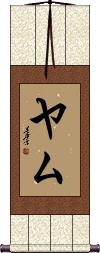
| Yam | ヤム | yamu | ||
| Yamada | 山田 | 山田 | ||
| Yamavakedma | ヤマバケドマ | yamabakedoma | ||
| Yambol | 揚博爾 扬博尔 | yáng bó ěr yang2 bo2 er3 yang bo er yangboer | yang po erh yangpoerh |
|
| Yambol | ヤンボル | yanboru | ||
| Yami | 亞米 亚米 | yà mǐ / ya4 mi3 / ya mi / yami | ya | |
| Yamila | 亞米拉 亚米拉 | yà mǐ lā ya4 mi3 la1 ya mi la yamila | ||
| Yamila | ヤミラ | yamira | ||
| Yamileth | 亞米萊斯 亚米莱斯 | yà mǐ lái sī ya4 mi3 lai2 si1 ya mi lai si yamilaisi | ya mi lai ssu yamilaissu |
|
| Yamileth | ヤミレス | yamiresu | ||
| In some entries above you will see that characters have different versions above and below a line. In these cases, the characters above the line are Traditional Chinese, while the ones below are Simplified Chinese. | ||||
All of our calligraphy wall scrolls are handmade.
When the calligrapher finishes creating your artwork, it is taken to my art mounting workshop in Beijing where a wall scroll is made by hand from a combination of silk, rice paper, and wood.
After we create your wall scroll, it takes at least two weeks for air mail delivery from Beijing to you.
Allow a few weeks for delivery. Rush service speeds it up by a week or two for $10!
When you select your calligraphy, you'll be taken to another page where you can choose various custom options.
The wall scroll that Sandy is holding in this picture is a "large size"
single-character wall scroll.
We also offer custom wall scrolls in small, medium, and an even-larger jumbo size.
Professional calligraphers are getting to be hard to find these days.
Instead of drawing characters by hand, the new generation in China merely type roman letters into their computer keyboards and pick the character that they want from a list that pops up.
There is some fear that true Chinese calligraphy may become a lost art in the coming years. Many art institutes in China are now promoting calligraphy programs in hopes of keeping this unique form
of art alive.
Even with the teachings of a top-ranked calligrapher in China, my calligraphy will never be good enough to sell. I will leave that to the experts.
The same calligrapher who gave me those lessons also attracted a crowd of thousands and a TV crew as he created characters over 6-feet high. He happens to be ranked as one of the top 100 calligraphers in all of China. He is also one of very few that would actually attempt such a feat.
Some people may refer to this entry as Yam Kanji, Yam Characters, Yam in Mandarin Chinese, Yam Characters, Yam in Chinese Writing, Yam in Japanese Writing, Yam in Asian Writing, Yam Ideograms, Chinese Yam symbols, Yam Hieroglyphics, Yam Glyphs, Yam in Chinese Letters, Yam Hanzi, Yam in Japanese Kanji, Yam Pictograms, Yam in the Chinese Written-Language, or Yam in the Japanese Written-Language.