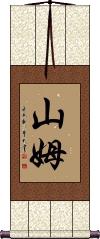
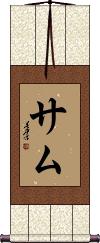
The Name Sam in Japanese/Chinese on a Custom-Made Wall Scroll.
Click the "Customize" button next to your name below to start your personalized sam calligraphy artwork...
Switched to secondary search mode due to lack of results using primary.
These secondary results may not be very accurate. Try a different but similar meaning word or phrase for better results. Or...
This is the Chinese name for the territory of American Samoa (formerly known as Eastern Samoa).
This should not be confused with Independent Somoa which is to the west.
If you want just a general “Samoa” title, just use the plain “Samoa” entry, as it does not actually designate western, eastern, American, or independent.
Sometimes called “The Seven Virtues of the Samurai,” “The Bushido Code,” or “The Samurai Code of Chivalry.”
This would be read in Chinese characters, Japanese Kanji, and old Korean Hanja as “The Way of the Warrior,” “The Warrior's Way,” or “The Warrior's Code.”
It's a set of virtues that the Samurai of Japan and ancient warriors of China and Korea had to live and die by. However, while known throughout Asia, this title is mostly used in Japan and thought of as being of Japanese origin.
The seven commonly-accepted tenets or virtues of Bushido are Rectitude 義, Courage 勇, Benevolence 仁, Respect 礼(禮), Honour 名誉, Honesty 誠, and Loyalty 忠実. These tenets were part of oral history for generations, thus, you will see variations in the list of Bushido tenets depending on who you talk to.
This Japanese proverb simply reads, “[In] Flowers it's Cherry Blossoms, [In] Men it's Warriors.”
花は櫻木人は武士 is meant to say that of all the flowers in the world, the cherry blossom is the best. And of all men in the world, the Samurai or Warrior is the best
This proverb has been around for a long time. It's believed to have been composed sometime before the Edo Period in Japan (which started in 1603).
Some will drop one syllable and pronounce this, “hana wa sakura hito wa bushi.” That's “sakura” instead of “sakuragi,” which is like saying “cherry blossom” instead of “cherry tree.”
The third character was traditionally written as 櫻. But in modern Japan, that became 桜. You may still see 櫻 used from time to time on older pieces of calligraphy. We can do either one, so just make a special request if you want 櫻.
Note: Because this selection contains some special Japanese Hiragana characters, it should be written by a Japanese calligrapher.
The 12th century phrase, 一所懸命 (Issho Kenmei) is often referred to as “Life Of A Samurai.”
Breaking it down:
一 = one
所 = place
懸 = devote
命 = life
一所懸命 literally means “to stake your life on one place.” Today, Japanese people use it to mean giving your full effort to something.
Other translations of 一所懸命 include: Very hard, with utmost effort, as hard as one can, with all one's might, for dear life, eagerly, and/or desperately.
In the context of the Samurai, it is devoting oneself to the defense of one's territory.
Originally 一生懸命 meaning “to stake your life on one birth.”
The 浪人 or Ronin have no master - The most famous are the 47 ronin created after their Lord committed suicide. This term was not a positive title for the Samurai of ancient Japan. However, in recent years, movies and video games have glorified the term Ronin.
In Chinese, this term has the original meaning of a hobo, vagabond, or ruffian.
In Korean Hanja, these characters would be read as adventurer, wanderer, someone without a steady job, or someone who is wasting away time.
In modern Japan, this term is used as a nickname for a high school student who has failed a college entry exam (and is trying again).
In Chinese and Korean, the Japanese definition of “Masterless Samurai” is known because of the historical context. Even in Japanese, the literal translation is closer to the Chinese and Korean definitions shown above.
This will make a fine wall scroll if you are a fan of the Ronin or see yourself as a Ronin of sorts. However, please think twice before getting a Ronin tattoo!
三昧 is the Chinese, Japanese Kanji, and old Korean Hanja way to write Samādhi.
Samadhi is the state of intense concentration achieved through meditation.
Some will define Samādhi as putting together, composing the mind, intent contemplation, perfect absorption, or union of the meditator with the object of meditation.
定 is the single-character way to express the idea of Samadhi in Chinese and Japanese.
A single-character title like this is open to a lot of interpretation. So 定 can mean to set, to fix, to determine, to decide, to order, certainly, truly, settle, or compose the mind.
In the Buddhist context, this means “Perfect absorption of thought into the one object of meditation,” “The mind fixed in one direction,” “Internal state of imperturbability or tranquility,” or “Exempt from all external sensations.”
The meaning of the name is “early-summer rain.” Literally, it's “5th moon rain,” which means “rain in the month of May.” This may refer to an anime character, a Japanese battleship in WWII, or a place in Japan called Samidare.
When the calligrapher finishes creating your artwork, it is taken to my art mounting workshop in Beijing where a wall scroll is made by hand from a combination of silk, rice paper, and wood.
After we create your wall scroll, it takes at least two weeks for air mail delivery from Beijing to you.
Allow a few weeks for delivery. Rush service speeds it up by a week or two for $10!
When you select your calligraphy, you'll be taken to another page where you can choose various custom options.
The wall scroll that Sandy is holding in this picture is a "large size" single-character wall scroll. We also offer custom wall scrolls in small, medium, and an even-larger jumbo size.
Professional calligraphers are getting to be hard to find these days. Instead of drawing characters by hand, the new generation in China merely type roman letters into their computer keyboards and pick the character that they want from a list that pops up.
There is some fear that true Chinese calligraphy may become a lost art in the coming years. Many art institutes in China are now promoting calligraphy programs in hopes of keeping this unique form
of art alive.
Even with the teachings of a top-ranked calligrapher in China, my calligraphy will never be good enough to sell. I will leave that to the experts.
The same calligrapher who gave me those lessons also
attracted a crowd of thousands and a TV crew as he created characters over
6-feet high. He happens to be ranked as one of the top 100 calligraphers
in all of China. He is also one of very few that would actually attempt
such a feat.
Some people may refer to this entry as Sam Kanji, Sam Characters, Sam in Mandarin Chinese, Sam Characters, Sam in Chinese Writing, Sam in Japanese Writing, Sam in Asian Writing, Sam Ideograms, Chinese Sam symbols, Sam Hieroglyphics, Sam Glyphs, Sam in Chinese Letters, Sam Hanzi, Sam in Japanese Kanji, Sam Pictograms, Sam in the Chinese Written-Language, or Sam in the Japanese Written-Language.