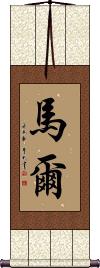
The following table may be helpful for those studying Chinese or Japanese:
Title
Characters
Romaji (Romanized Japanese)
Various forms of Romanized Chinese
Mar
馬爾马尔
mǎ ěr / ma3 er3 / ma er / maer
ma erh / maerh
In some entries above you will see that characters have different versions above and below a line. In these cases, the characters above the line are Traditional Chinese, while the ones below are Simplified Chinese.
When the calligrapher finishes creating your artwork, it is taken to my art mounting workshop in Beijing where a wall scroll is made by hand from a combination of silk, rice paper, and wood.
After we create your wall scroll, it takes at least two weeks for air mail delivery from Beijing to you.
Allow a few weeks for delivery. Rush service speeds it up by a week or two for $10!
When you select your calligraphy, you'll be taken to another page where you can choose various custom options.
The wall scroll that Sandy is holding in this picture is a "large size" single-character wall scroll. We also offer custom wall scrolls in small, medium, and an even-larger jumbo size.
Professional calligraphers are getting to be hard to find these days. Instead of drawing characters by hand, the new generation in China merely type roman letters into their computer keyboards and pick the character that they want from a list that pops up.
There is some fear that true Chinese calligraphy may become a lost art in the coming years. Many art institutes in China are now promoting calligraphy programs in hopes of keeping this unique form
of art alive.
Even with the teachings of a top-ranked calligrapher in China, my calligraphy will never be good enough to sell. I will leave that to the experts.
The same calligrapher who gave me those lessons also
attracted a crowd of thousands and a TV crew as he created characters over
6-feet high. He happens to be ranked as one of the top 100 calligraphers
in all of China. He is also one of very few that would actually attempt
such a feat.
Some people may refer to this entry as Mar Kanji, Mar Characters, Mar in Mandarin Chinese, Mar Characters, Mar in Chinese Writing, Mar in Japanese Writing, Mar in Asian Writing, Mar Ideograms, Chinese Mar symbols, Mar Hieroglyphics, Mar Glyphs, Mar in Chinese Letters, Mar Hanzi, Mar in Japanese Kanji, Mar Pictograms, Mar in the Chinese Written-Language, or Mar in the Japanese Written-Language.