I am shipping orders on Saturday this week. News and More Info
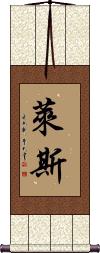
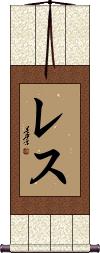
Click the "Customize" button next to your name below to start your personalized les calligraphy artwork...
Switched to secondary search mode due to lack of results using primary.
These secondary results may not be very accurate. Try a different but similar meaning word or phrase for better results. Or...
Look up Les in my Japanese Kanji & Chinese Character Dictionary(My dictionary is a different system then the calligraphy search you just tried)
If you want a special phrase, word, title, name, or proverb, feel free to contact me, and I will translate your custom calligraphy idea for you.
2. Achilles
3. Alesha
4. Alesia
5. Alesiarae
6. Alessa
7. Alessandra
8. Alessandro
9. Alessia
10. Alessio
11. Angeles
13. Aquiles
14. Ballesta
15. The Beatles
17. Bless this House
18. Blessed by God
22. Brahmavihara - The Four Immeasurables
23. The Principles of Buddhism
24. Carles
25. Celeste
26. Celestial Dragon
27. Celestin
28. Celestine
29. Celestino
30. Celestinus
31. Charles
32. Charleston
34. Colesan
35. Brought Together from 1000 Miles Away by Fate
36. Divine Blessing
37. Grace of God / Divine Blessing
38. Elessar
39. Elless
41. The Five Principles of Reiki
42. Giles
43. Gilles
44. God Bless You
45. God Bless You / May God Protect You
46. God Bless You / God Be With You
47. Gonzales
49. Heaven Blessing
51. Heaven Blesses the Diligent
54. Iglesias
55. Infinity / Infinite / Endless / Boundless
56. A Journey of 1000 Miles Begins with a Single Step
57. Jules
58. Kalesh
59. Kallesh
60. Know Your Enemy, Know Yourself, and Win 100 Battles
61. Les
62. Lesley
63. Leslie
十法 is the title of the ten perfect or perfecting Mahāyāna rules.
The order of rules is as follows:
1. right belief.
2. right conduct.
3. right spirit.
4. the joy of the bodhi mind.
5. joy in the dharma.
6. joy in meditation.
7. pursuing the correct dharma.
8. obedience to, or accordance with dharma.
9. departing from pride, desire, etc.
10. comprehending the inner teaching of Buddha and taking no pleasure in attaining such knowledge or noting the ignorance of others.
This title is only used in the context of Buddhism. Japanese and Chinese people who are not familiar with Buddhism will not recognize this title.
The condition of perfect meditation
安住不動 means at peace and immovable.
The first two Kanji mean being content with one's present position or well-composed.
The last two Kanji mean immobile, firmness, fixed, and/or motionless.
In the Zen school, this is being well-composed and immovable - the ideal state of Zen meditation.
五福臨門 means “five good fortunes arrive [at the] door.”
It is understood to mean “may the five blessings descend upon this home.”
These blessings are known in ancient China to be: longevity, wealth, health, virtue, and natural death (living to old age). This is one of several auspicious sayings you might hear during the Chinese New Year.
This means “Bless this house” or “Bless this home,” in Japanese.
Some may also translate this as “Bless this family,” since the Kanji for home can also mean family.
Note: Because this selection contains some special Japanese Hiragana characters, it should be written by a Japanese calligrapher.
祝福 is a nice way to give good wishes to someone.
It can be a general blessing or used to congratulate someone for a special occasion or graduation.
This has a good meaning in Japanese but is more appropriate when expressed orally. 祝福 is not a natural selection for a wall scroll if your audience is Japanese.
Perhaps a pacifist view or perhaps the best kind of victory; 兵不血刃 reflect this idea:
The edges of the swords not being stained with blood.
You could also translate it as: Win victory without firing a shot.
The first character means army or force. The second character means without or none. The last two characters mean bloodstained knives. So it represents a returning victorious army without bloodstained knives. 兵不血刃 is the very literal sense of this Chinese proverb. The title definition is more accurate to the way this proverb is understood.
Asking yourself why the direct or literal translation is different?
...Think of compound words in English such as “nevertheless” if we break it apart to “never the less,” we will have trouble getting the real definition of “in spite of that.” Similar things happen when multiple characters create a compounded word in Chinese.
四無量心 is the cattāri brahmavihārā or catvāri apramāṇāni.
The four immeasurables, or infinite Buddha-states of mind. These four dhyānas include:
1. 慈無量心 boundless kindness, maitrī, or bestowing of joy or happiness.
2. 悲無量心 boundless pity, karuṇā, to save from suffering.
3. 喜無量心 boundless joy, muditā, on seeing others rescued from suffering.
4. 捨無量心 limitless indifference, upekṣā, i.e., rising above these emotions or giving up all things.
In short, 佛義 is the Principles of Buddhism, but there is more (especially for the second character):
佛 is the character for the Buddha and Buddhism.
義 has deeper meanings including justice, righteousness, morality, honour/honor, teachings, doctrine, right, proper, righteous, loyalty, purpose, or meaning. So the single word “principles” is often used to encompass all these ideas.
天竜人 is Celestial Dragon or Tenryūbito in Japanese.
This title is associated with the One Piece Manga/Anime series. This title is also translated in this context as “World Nobles” with the literal meaning “Heavenly Dragon Folk” or “Heaven Dragon Person/People.”
Can also be romanized as Tenryūbito, Tenryūhito, or Tenryūjin.
有緣千里來相會 means that fate or destiny has caused us to meet from a thousand miles away.
The 有緣 part suggests something that is connected as if by a thread due to fate, destiny, or karma.
This romantic phrase is seen in Chinese greeting cards. It relays the idea that your love was meant to be and that you were destined to meet (regardless of what distance or obstacles might have made such a meeting unlikely).
See Also: Red Thread
大胆不敵 is a Japanese word that can mean a few things depending on how you read it.
Popular translations include fearless, audacity (the attitude of a) daredevil, or daring.
The first two Kanji create a word that means: bold, fearless, or daring; audacious.
The last two Kanji create a word meaning: no match for, cannot beat, daring, fearless, intrepid, bold, or tough.
As with many Japanese words, the two similar-meaning words work together to multiply the meaning and intensity of the whole 4-Kanji word.
Reiki Gokai
These are the five principles of Reiki.
They translate into English as...
At least for today:
Do not be angry,
Do not worry,
Be grateful,
Work with diligence,
Be kind to people.
Note: Because this selection contains some special Japanese Hiragana characters, it should be written by a Japanese calligrapher.
上帝保佑 is a blessing exchanged between Chinese Christians.
The first two characters mean God (The God of Zion). The second two characters express the idea of giving protection. Another way to translate this is “May God protect you.”
See Also: Guardian Angel
神さまが守るように is about as close as you can get to, “God Bless You” in Japanese.
This literally means “[May] God Protect [You].” It can also mean “God is Always With You,” as the word in this phrase that means “protect” can also mean to follow or be with. In fact, the Japanese dictionary entry for that word reads like this: to protect; to guard; to defend; to keep (i.e. a promise); to abide; to observe; to follow.
Note: Because this selection contains some special Japanese Hiragana characters, it should be written by a Japanese calligrapher.
天恵 means “Heaven's Blessing,” “Blessings from Heaven,” or “Blessed by Heaven” in Japanese Kanji.
Depending on the context in which this is used, it can also mean “gift of nature,” or even “natural resources” (as in Heaven or God bestowed things like oil, iron, gold, and other natural resources upon mankind).
天道酬勤 can be interpreted in a few different ways:
God blesses those who work hard.
It is the way of Heaven to smile on the diligent.
God will reward those that are worthy.
Heaven blesses those who are diligent.
Whichever translation you like, a scroll like this on your wall may serve as a reminder to work hard because your diligence will pay off both in this life and the next.
Note: This can be pronounced in Korean, but it's not a commonly used term.
天上 is a Chinese, Japanese, and Korean word that means celestial or heavenly.
You can directly translate this as “heavens above,” or “sky above.”
Do not bow down for the sake of five pecks of rice
不为五斗米折腰 is a Chinese idiom/proverb that speaks of being above bribes and not losing face or honor for short-term gain.
Some may also translate the perceived meaning as “high-hearted” or “integrity beyond reproach.”
The more literal meaning is “Do not bow down for the sake of five pecks of rice.”
(Chinese / Korean)
無窮 is the Chinese and Korean word meaning infinity, eternity, infinitude, infinite or endless.
無窮 literally translates as “without [ever becoming] exhausted/poor,” and in that context, can mean “inexhaustible” or “boundless” but this is usually read as “without end.” Some extended definitions include eternity, infinitude, or immortality.
In certain contexts, it can mean “immortality.”
The first character means “never” or “not.” The second means “exhausted,” “finished,” or “ending.”
Note: 無窮 is a Japanese word but rarely used in modern Japan.
senri no michi mo ippo kara
千里の道も一歩から is the Japanese version of an ancient Chinese proverb that means “a journey of a thousand miles begins with a single step.”
Some will also translate this as a 1000-mile road starts with one brick (a small amount).
In this case, the real measurement is an ancient Chinese “li” or 里, which is romanized as “ri” in Japanese. It's about half a kilometer, so three 里 would be a western mile. A journey of 333 miles begins with a single step, just doesn't sound as natural.
Note: Because this selection contains some special Japanese Hiragana characters, it should be written by a Japanese calligrapher.
敵を知り己を知れば百戦危うからず is the longer/full Japanese version of this proverb. This means “Know your enemy, know yourself, and you will not fear a hundred battles.”
Others will translate this as “Know thy enemy, know thyself, yields victory in one hundred battles.”
Note: Because this selection contains some special Japanese Hiragana characters, it should be written by a Japanese calligrapher.
All of our calligraphy wall scrolls are handmade.
When the calligrapher finishes creating your artwork, it is taken to my art mounting workshop in Beijing where a wall scroll is made by hand from a combination of silk, rice paper, and wood.
After we create your wall scroll, it takes at least two weeks for air mail delivery from Beijing to you.
Allow a few weeks for delivery. Rush service speeds it up by a week or two for $10!
When you select your calligraphy, you'll be taken to another page where you can choose various custom options.
The wall scroll that Sandy is holding in this picture is a "large size"
single-character wall scroll.
We also offer custom wall scrolls in small, medium, and an even-larger jumbo size.
Professional calligraphers are getting to be hard to find these days.
Instead of drawing characters by hand, the new generation in China merely type roman letters into their computer keyboards and pick the character that they want from a list that pops up.
There is some fear that true Chinese calligraphy may become a lost art in the coming years. Many art institutes in China are now promoting calligraphy programs in hopes of keeping this unique form
of art alive.
Even with the teachings of a top-ranked calligrapher in China, my calligraphy will never be good enough to sell. I will leave that to the experts.
The same calligrapher who gave me those lessons also attracted a crowd of thousands and a TV crew as he created characters over 6-feet high. He happens to be ranked as one of the top 100 calligraphers in all of China. He is also one of very few that would actually attempt such a feat.
Some people may refer to this entry as Les Kanji, Les Characters, Les in Mandarin Chinese, Les Characters, Les in Chinese Writing, Les in Japanese Writing, Les in Asian Writing, Les Ideograms, Chinese Les symbols, Les Hieroglyphics, Les Glyphs, Les in Chinese Letters, Les Hanzi, Les in Japanese Kanji, Les Pictograms, Les in the Chinese Written-Language, or Les in the Japanese Written-Language.