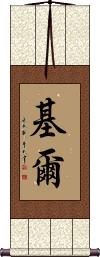
I am shipping orders on Thursday this week. News and More Info
Click the "Customize" button next to your name below to start your personalized kir calligraphy artwork...
Switched to secondary search mode due to lack of results using primary.
These secondary results may not be very accurate. Try a different but similar meaning word or phrase for better results. Or...
Look up Kir in my Japanese Kanji & Chinese Character Dictionary(My dictionary is a different system then the calligraphy search you just tried)
If you want a special phrase, word, title, name, or proverb, feel free to contact me, and I will translate your custom calligraphy idea for you.
1. Akira
2. Ikiro
4. Kir
5. Kira
6. Kiran
7. Kirandeep
8. Kirani
9. Kiranieg
10. Kirby
11. Kire
12. Kiri
13. Kiriana
14. Kiribati
15. Kiril
16. Kirill
17. Kirin / Giraffe / Mythical Creature
18. Kirk
19. Kirsten
20. Kirstie
21. Kirsty
22. Kiru
23. Kirwa
24. Shakira
25. Zakir
生きる is a Japanese title that means to live, to exist, to make a living, to subsist, to come to life, or to be enlivened.
生きる is also the title of a 1952 Japanese movie that uses the translated English title of “To Live.”
This term, when used in the context of baseball, and some Japanese games such as “go,” can mean “safe.”
Note: Because this selection contains some special Japanese Hiragana characters, it should be written by a Japanese calligrapher.
麒麟 is the title of a mythical beast of Asia.
The animal is thought to be related to the giraffe, and in some ways, it is a giraffe. However, it is often depicted with the horns of a dragon or deer and sometimes with the body like a horse, but many variations exist.
In Japanese, it is pronounced “Kirin” as in “Kirin Ichiban” beer.

Notes:
1. This is sometimes spelled as “kylin.”
2. In Japanese, this is the only Kanji word for giraffe. Therefore in Japan, this word needs context to know whether you are talking about the mythical creature or the long-necked giraffe of Africa.
3. Apparently, this was the first word used for regular giraffes in China (some were brought from Africa to China during the Ming Dynasty - probably around the year 1400). Though the mythical creature may have existed before, the name “qilin” was given to the “new giraffe.” This is because, more than 600 years ago, giraffes somewhat matched the mythical creature's description when Chinese people saw them for the first time. Later, to avoid such an ambiguous title, a three-character word was devised to mean a “giraffe of Africa.” The characters for “qilin” shown here are only for the mythological version in modern Chinese.
4. More information about the qilin / kirin from Wikipedia.
5. This creature is sometimes translated as the “Chinese Unicorn,” although it is generally portrayed with two horns. I think this is done more for the fantasy aspect of the unicorn and because most westerners don't know what a qilin or kirin is (this avoids a long explanation by the translator).
6. In Korean, this can mean kirin or simply giraffe (usually, the mythological creature is what they would think of when seeing these characters alone on a wall scroll).
The following table may be helpful for those studying Chinese or Japanese...
| Title | Characters | Romaji (Romanized Japanese) | Various forms of Romanized Chinese | |
| Akira | 阿基拉 | ā jī lā / a1 ji1 la1 / a ji la / ajila | a chi la / achila | |
| Akira | アキラ | akira | ||
| Ikiro | イキロ | ikiro | ||
| Ikiru To Live | 生きる | ikiru | ||
| Kir | 基爾 基尔 | jī ěr / ji1 er3 / ji er / jier | chi erh / chierh | |
| Kir | キル | kiru | ||
| Kira | 吉拉 | jí lā / ji2 la1 / ji la / jila | chi la / chila | |
| Kira | 琦拉 | qí lā / qi2 la1 / qi la / qila | ch`i la / chila / chi la | |
| Kira | キラ | kira | ||
| Kiran | 基蘭 基兰 | jī lán / ji1 lan2 / ji lan / jilan | chi lan / chilan | |
| Kiran | 凱蘭 凯兰 | kǎi lán / kai3 lan2 / kai lan / kailan | k`ai lan / kailan / kai lan | |
| Kiran | キラン | kiran | ||
| Kirandeep | 基蘭迪普 基兰迪普 | jī lán dí pǔ ji1 lan2 di2 pu3 ji lan di pu jilandipu | chi lan ti p`u chilantipu chi lan ti pu |
|
| Kirandeep | キランディープ | kirandiipu / kirandipu | ||
| Kirani | 基拉尼 | jī lā ní ji1 la1 ni1 ji la ni jilani | chi la ni chilani |
|
| Kirani | キラニ | kirani | ||
| Kiranieg | キラニエグ | kiraniegu | ||
| Kirby | 柯比 | kē bǐ / ke1 bi3 / ke bi / kebi | k`o pi / kopi / ko pi | |
| Kirby | カービー | kaa bii / kaabii / ka bi | ||
| Kire | 基爾 基尔 | jī ěr / ji1 er3 / ji er / jier | chi erh / chierh | |
| Kire | キア | kia | ||
| Kiri | 基里 | jī lǐ / ji1 li3 / ji li / jili | chi li / chili | |
| Kiri | キリ | kiri | ||
| Kiriana | 基里安娜 | jī lǐ ān nà ji1 li3 an1 na4 ji li an na jilianna | chi li an na chilianna |
|
| Kiriana | キリアナ | kiriana | ||
| Kiribati | 基里巴斯 | jī lǐ bā sī ji1 li3 ba1 si1 ji li ba si jilibasi | chi li pa ssu chilipassu |
|
| Kiribati | キリバス | kiribasu | ||
| Kiril | 科瑞爾 科瑞尔 | kē ruì ěr ke1 rui4 er3 ke rui er keruier | k`o jui erh kojuierh ko jui erh |
|
| Kiril | キリル | kiriru | ||
| Kirill | 基里爾 基里尔 | jī lǐ ěr ji1 li3 er3 ji li er jilier | chi li erh chilierh |
|
| Kirill | キリル | kiriru | ||
| Kirin Giraffe Mythical Creature | 麒麟 | kirin | qí lǐn / qi2 lin3 / qi lin / qilin | ch`i lin / chilin / chi lin |
| Kirk | 柯剋 柯克 | kē kè / ke1 ke4 / ke ke / keke | k`o k`o / koko / ko ko | |
| Kirk | カーク | kaaku / kaku | ||
| Kirsten | 克爾斯滕 克尔斯滕 | kè ěr sī téng ke4 er3 si1 teng2 ke er si teng keersiteng | k`o erh ssu t`eng koerhssuteng ko erh ssu teng |
|
| Kirsten | キルステン | kirusuten | ||
| Kirstie | 祺爾史迪 祺尔史迪 | qí ěr shǐ dí qi2 er3 shi3 di2 qi er shi di qiershidi | ch`i erh shih ti chierhshihti chi erh shih ti |
|
| Kirstie | カースティ | kaasuti / kasuti | ||
| Kirsty | 科斯蒂 | kē sī dì ke1 si1 di4 ke si di kesidi | k`o ssu ti kossuti ko ssu ti |
|
| Kirsty | カースチイ | kaasutii / kasuti | ||
| Kiru | 基魯 基鲁 | jī lǔ / ji1 lu3 / ji lu / jilu | chi | |
| Kiru | きる | kiru | ||
| Kirwa | 基爾瓦 基尔瓦 | jī ěr wǎ ji1 er3 wa3 ji er wa jierwa | chi erh wa chierhwa |
|
| Kirwa | キルワ | kiruwa | ||
| Shakira | 夏奇拉 | xià qí lā xia4 qi2 la1 xia qi la xiaqila | hsia ch`i la hsiachila hsia chi la |
|
| Shakira | シャキラ | shakira | ||
| Zakir | 扎基爾 扎基尔 | zhā jī ěr zha1 ji1 er3 zha ji er zhajier | cha chi erh chachierh |
|
| Zakir | ザキル | zakiru | ||
| In some entries above you will see that characters have different versions above and below a line. In these cases, the characters above the line are Traditional Chinese, while the ones below are Simplified Chinese. | ||||
All of our calligraphy wall scrolls are handmade.
When the calligrapher finishes creating your artwork, it is taken to my art mounting workshop in Beijing where a wall scroll is made by hand from a combination of silk, rice paper, and wood.
After we create your wall scroll, it takes at least two weeks for air mail delivery from Beijing to you.
Allow a few weeks for delivery. Rush service speeds it up by a week or two for $10!
When you select your calligraphy, you'll be taken to another page where you can choose various custom options.
The wall scroll that Sandy is holding in this picture is a "large size"
single-character wall scroll.
We also offer custom wall scrolls in small, medium, and an even-larger jumbo size.
Professional calligraphers are getting to be hard to find these days.
Instead of drawing characters by hand, the new generation in China merely type roman letters into their computer keyboards and pick the character that they want from a list that pops up.
There is some fear that true Chinese calligraphy may become a lost art in the coming years. Many art institutes in China are now promoting calligraphy programs in hopes of keeping this unique form
of art alive.
Even with the teachings of a top-ranked calligrapher in China, my calligraphy will never be good enough to sell. I will leave that to the experts.
The same calligrapher who gave me those lessons also attracted a crowd of thousands and a TV crew as he created characters over 6-feet high. He happens to be ranked as one of the top 100 calligraphers in all of China. He is also one of very few that would actually attempt such a feat.
Some people may refer to this entry as Kir Kanji, Kir Characters, Kir in Mandarin Chinese, Kir Characters, Kir in Chinese Writing, Kir in Japanese Writing, Kir in Asian Writing, Kir Ideograms, Chinese Kir symbols, Kir Hieroglyphics, Kir Glyphs, Kir in Chinese Letters, Kir Hanzi, Kir in Japanese Kanji, Kir Pictograms, Kir in the Chinese Written-Language, or Kir in the Japanese Written-Language.