I am shipping orders on Saturday this week. News and More Info

The Name Kaz in Japanese/Chinese on a Custom-Made Wall Scroll.

Click the "Customize" button next to your name below to start your personalized kaz calligraphy artwork...

Switched to secondary search mode due to lack of results using primary.
These secondary results may not be very accurate. Try a different but similar meaning word or phrase for better results. Or...

Look up Kaz in my Japanese Kanji & Chinese Character Dictionary(My dictionary is a different system then the calligraphy search you just tried)

If you want a special phrase, word, title, name, or proverb, feel free to contact me, and I will translate your custom calligraphy idea for you.


  1. Furinkazan

  2. Kakazu

  3. Kamikaze / Divine Wind

  4. Kaz

  5. Kazakhstan

  6. Kazeou

  7. Kaziah

  8. Kazimierz

  9. Kazuya

10. Makaze / True Wind

11. Seikaze

12. Mujo no Kaze / Wind of Impermanence


Furinkazan

military strategy

 fēng lín huǒ shān
 fuu rin ka zan
Furinkazan Scroll

風林火山 is the battle strategy and proverb of Japanese feudal lord Takeda Shingen (1521-1573 AD).

This came from the Art of War by Chinese strategist and tactician Sun Tzu (Sunzi).

You can think of this as an abbreviation to remind officers and troops how to conduct battle.

風林火山 is a word list: Wind, Forest, Fire, Mountain.

The more expanded meaning is supposed to be...

“Swift as the wind, quiet as the forest, fierce as fire, and immovable as a mountain”

“As fast as the wind, as quiet as the forest, as daring as fire, and immovable as the mountain”

“Move as swift as the wind, stay as silent as a forest, attack as fierce as fire, undefeatable defense like a mountain”

“Move swiftly like the wind, stay silent like the forest, attack fiercely like fire, take a tactical position on the mountain”


See Also:  Art of War

Kakazu

Surname

 kakazu
Kakazu Scroll

This is the most common version of the Japanese surname Kakazu in Kanji.

A more rare version is 加数.

Kamikaze / Divine Wind

 kami kaze
Kamikaze / Divine Wind Scroll

神風 is the famous title used during WWII to describe Japanese fighter plane pilots, many of whom performed suicide attacks by flying their planes into ships and other Allied targets.

The Japanese word, Kamikaze actually means “divine wind.”


See Also:  Kamikaze

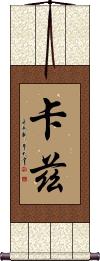
 kǎ zī
Kaz Scroll

卡茲 is the name Kaz in Chinese (Mandarin).

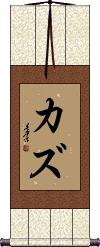
 kazu
Kaz Scroll

カズ is the name Kaz in Japanese Katakana.


Note: Because this title is entirely Japanese Katakana, it should be written by a Japanese calligrapher.

 hā sà kè sī tǎn
Kazakhstan Scroll

This is the Chinese name for the country of Kazakhstan.


See Also:  Asia

 kazafusutan
Kazakhstan Scroll

This is the Japanese name for the country of Kazakhstan.


Note: Because this title is entirely Japanese Katakana, it should be written by a Japanese calligrapher.


See Also:  Asia

 kǎ zé wū
Kazeou Scroll

卡澤烏 is the name Kazeou in Chinese (Mandarin).

 kǎ qí yà
Kaziah Scroll

卡齊亞 is the name Kaziah in Chinese (Mandarin).

 kajia
Kaziah Scroll

カジア is the name Kaziah in Japanese Katakana.


Note: Because this title is entirely Japanese Katakana, it should be written by a Japanese calligrapher.

 kǎ rè mǐ āi
Kazimierz Scroll

This is a common Mandarin Chinese transliteration for the male Polish name Kazimierz.

 kazuya
Kazuya Scroll

一八 is the female given name Kazuya.

This is the same name as used for Kazuya Mishima.

This is also a word that means wall iris, roof iris, Iris tectorum, or fleur-de-lis.

Makaze / True Wind

 maji / makaze
Makaze / True Wind Scroll

This Japanese word means southerly breeze or true wind.

This can also be a Japanese surname that is romanized as Makaze.

 jìng fēng
 seikaze / seifuu
Seikaze Scroll

静風 means quiet wind, silent wind, or serenity wind.

This can also be a given name often pronounced Seifū in Japanese and can also be pronounced Shizukaze in Japanese.

Some might also write this as 靜風 with a slight difference in the first character.

In Simplified Chinese, it's 静风.
This word is more commonly used in Japanese than Chinese, but it can be read in both languages with the same meaning.

Mujo no Kaze / Wind of Impermanence

 mu jou no kaze
Mujo no Kaze / Wind of Impermanence Scroll

無常の風 is an old Japanese proverb that means the wind of impermanence or the wind of change in Japanese.

This can refer to the force that ends life, like the wind scattering a flower's petals. Life is yet another impermanent existence that is fragile, blown out like a candle.

The first two characters mean uncertainty, transiency, impermanence, mutability, variable, and/or changeable.

In some Buddhist contexts, 無常 can be analogous to a spirit departing at death (with a suggestion of the impermanence of life).

The last two characters mean “of wind” or a possessive like “wind of...” but Japanese grammar will have the wind come last in the phrase.


The following table may be helpful for those studying Chinese or Japanese...

Title CharactersRomaji (Romanized Japanese)Various forms of Romanized Chinese
Furinkazan風林火山
风林火山
fuu rin ka zan
fuurinkazan
fu rin ka zan
fēng lín huǒ shān
feng1 lin2 huo3 shan1
feng lin huo shan
fenglinhuoshan
Kakazu嘉數
嘉数
kakazu
Kamikaze
Divine Wind
神風
神风
kami kaze / kamikaze
Kaz卡茲
卡兹
kǎ zī / ka3 zi1 / ka zi / kazik`a tzu / katzu / ka tzu
Kazカズkazu
Kazakhstan哈薩克斯坦
哈萨克斯坦
hā sà kè sī tǎn
ha1 sa4 ke4 si1 tan3
ha sa ke si tan
hasakesitan
ha sa k`o ssu t`an
hasakossutan
ha sa ko ssu tan
Kazakhstanカザフスタンkazafusutan
Kazeou卡澤烏
卡泽乌
kǎ zé wū
ka3 ze2 wu1
ka ze wu
kazewu
k`a tse wu
katsewu
ka tse wu
Kaziah卡齊亞
卡齐亚
kǎ qí yà
ka3 qi2 ya4
ka qi ya
kaqiya
k`a ch`i ya
kachiya
ka chi ya
Kaziahカジアkajia
Kazimierz卡熱米埃
卡热米埃
kǎ rè mǐ āi
ka3 re4 mi3 ai1
ka re mi ai
karemiai
k`a je mi ai
kajemiai
ka je mi ai
Kazuya一八kazuya
Makaze
True Wind
真風maji / makaze
Seikaze静風/靜風
静风
seikaze / seifuu
seikaze / seifu
jìng fēng
jing4 feng1
jing feng
jingfeng
ching feng
chingfeng
Mujo no Kaze
Wind of Impermanence
無常の風mu jou no kaze
mujounokaze
mu jo no kaze
In some entries above you will see that characters have different versions above and below a line.
In these cases, the characters above the line are Traditional Chinese, while the ones below are Simplified Chinese.


Dictionary

Lookup Kaz in my Japanese & Chinese Dictionary

All of our calligraphy wall scrolls are handmade.

When the calligrapher finishes creating your artwork, it is taken to my art mounting workshop in Beijing where a wall scroll is made by hand from a combination of silk, rice paper, and wood.
After we create your wall scroll, it takes at least two weeks for air mail delivery from Beijing to you.

Allow a few weeks for delivery. Rush service speeds it up by a week or two for $10!

When you select your calligraphy, you'll be taken to another page where you can choose various custom options.


A nice Chinese calligraphy wall scroll

The wall scroll that Sandy is holding in this picture is a "large size"
single-character wall scroll.
We also offer custom wall scrolls in small, medium, and an even-larger jumbo size.

A professional Chinese Calligrapher

Professional calligraphers are getting to be hard to find these days.
Instead of drawing characters by hand, the new generation in China merely type roman letters into their computer keyboards and pick the character that they want from a list that pops up.

There is some fear that true Chinese calligraphy may become a lost art in the coming years. Many art institutes in China are now promoting calligraphy programs in hopes of keeping this unique form of art alive.

Trying to learn Chinese calligrapher - a futile effort

Even with the teachings of a top-ranked calligrapher in China, my calligraphy will never be good enough to sell. I will leave that to the experts.

A high-ranked Chinese master calligrapher that I met in Zhongwei

The same calligrapher who gave me those lessons also attracted a crowd of thousands and a TV crew as he created characters over 6-feet high. He happens to be ranked as one of the top 100 calligraphers in all of China. He is also one of very few that would actually attempt such a feat.


Some people may refer to this entry as Kaz Kanji, Kaz Characters, Kaz in Mandarin Chinese, Kaz Characters, Kaz in Chinese Writing, Kaz in Japanese Writing, Kaz in Asian Writing, Kaz Ideograms, Chinese Kaz symbols, Kaz Hieroglyphics, Kaz Glyphs, Kaz in Chinese Letters, Kaz Hanzi, Kaz in Japanese Kanji, Kaz Pictograms, Kaz in the Chinese Written-Language, or Kaz in the Japanese Written-Language.