I am shipping orders on Saturday this week. News and More Info
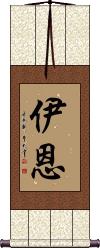
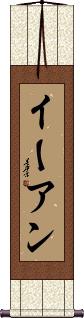
Click the "Customize" button next to your name below to start your personalized ian calligraphy artwork...
Switched to secondary search mode due to lack of results using primary.
These secondary results may not be very accurate. Try a different but similar meaning word or phrase for better results. Or...
Look up Ian in my Japanese Kanji & Chinese Character Dictionary(My dictionary is a different system then the calligraphy search you just tried)
If you want a special phrase, word, title, name, or proverb, feel free to contact me, and I will translate your custom calligraphy idea for you.
4. Abian
5. Adrian
6. Adriana
7. Adrianna
8. Adrianne
9. Adriano
10. Aldrian
11. Alexiane
12. Aliana
13. Aliannah
14. Alvian
15. Andrian
16. Ardian
17. Arian
18. Ariana
19. Ariane
20. Arianna
21. Arianne
22. Arriano
24. Asian Pride / Oriental Pride / AZN Pryde
25. Audreyiana
26. Audriana
27. Aureliano
28. Auriane
29. Avianna
30. Bastian
32. Bianca
33. Biancha
34. Biang
35. Bibian
36. Bibiana
37. Breian
38. Brian
39. Briana
40. Brianna
41. Capriana
42. Casiano
43. Christian
44. Christian / Disciple of Christ
46. Christian Friend
47. Christian
49. Christiana
50. Christiane
51. Christianne
52. Cian
53. Ciana
54. Ciane
55. Cianna
56. Cillian
57. Cipriano
Here is 1st Corinthians 13:4-8 (just the first sentence of verse 8) in Japanese.
In the familiar NIV, this would read:
Love is patient, love is kind. It does not envy, it does not boast, it is not proud.
It does not dishonor others, it is not self-seeking, it is not easily angered, it keeps no record of wrongs.
Love does not delight in evil but rejoices with the truth.
It always protects, always trusts, always hopes, always perseveres.
Love never fails...
The Japanese text is from the 新改訳聖書 (Shinkaiyaku) or New Japanese Bible. Popular among most Protestant denominations in modern Japan.
Note: Because this selection contains some special Japanese Hiragana characters, it should be written by a Japanese calligrapher.
Here is 1 Corinthians 13:5 in Chinese.
The text with punctuation:
不作害羞的事。不求自己的益处。不轻易发怒。不计算人的恶。
Hand-painted calligraphy does not retain punctuation.
This translation is from the Chinese Union Bible.
You may know it from the KJV as:
Doth not behave itself unseemly, seeketh not her own, is not easily provoked, thinketh no evil.
Here is 1 Corinthians 14:22 in Chinese.
The text with punctuation:
这样看来,说方言,不是为信的人作证据,乃是为不信的人。作先知讲道,不是为不信的人作证据,乃是为信的人。
Hand-painted calligraphy does not retain punctuation.
This translation is from the Chinese Union Bible.
You may know it from the KJV as:
Wherefore tongues are for a sign, not to them that believe, but to them that believe not: but prophesying serveth not for them that believe not, but for them which believe.
東方自尊 is the universal way to write “Asian Pride.”
We worked on this one for a long time. The effort involved both Chinese and Japanese translators and lengthy discussions. If you have been searching for this term, there is a reason that it's hard to find the way to write “Asian Pride” in Chinese and Japanese - it's because of the inherent difficulties in figuring out a universal combination of characters that can be read in all languages that use forms of Chinese characters.
This final solution that you see to the left creates a reasonable title in Chinese and an exotic (perhaps unusual) title in Japanese (This could be read as “Eastern Self-Respect” in Japanese”).
Although not as natural, it does have the same meaning as Korean Hanja, and the older generation of Vietnamese people will be able to read it.
The first two characters literally mean “Oriental” and the second two mean “pride,” “self-esteem,” or “self-respect” (we chose the most non-arrogant way to say “pride”). If you have “Asian Pride” (sometimes spelled Asian Pryde) these are the characters for you.
Note: For those who wonder, there is nothing technically wrong with the word “Oriental.” It is a correct word, and any bad meanings were created by so-called “Asian Americans” and Caucasians in the United States. To say “Asian” would not completely correct the intended meaning since that would include people from Saudi Arabia, Iraq, Iran, India, and portions of Russia.
For further proof, if you were of East Asian ancestry and born in England, you would be known as a “British Oriental” (The “Oriental stigma” is basically an American creation and, therefore, applies mainly to the American English language - where they get a bit overzealous with political correctness).
Further, since the Chinese and Japanese word for Oriental is not English, they can not be construed as having ill meaning. On one trip to China or Japan, you will find many things titled with these two characters, such as malls, buildings, and business names. These places also use “Oriental” as their English title (much as we do since our Chinese business name starts with these same two characters).
In short, the first two characters have the meaning that Americans attach to “Asian” but is more technically correct.
美容師 means beautician in Korean and Chinese but can mean hairdresser (especially in Japan).
克里斯蒂安 is the transliteration to Mandarin Chinese for the given name Christian.
See Also: Christianity
基督徒 is a very strong and direct word in Chinese for “Christian.”
The literal translation of the first two characters is “Christ.”
The last character means apprentice, follower, or disciple.
Altogether these three characters mean “Christ's Disciple” or “Christ's Apprentice.” 基督徒 is a pretty cool title to hang on your wall if you are a devout Christian.
Also used by Japanese Christians (but may be unfamiliar to non-Christian Japanese people).
See Also: Jesus Christ | God of Abraham
基督教徒 is the most verbose (longest) word for “Christian” in the Chinese and Japanese languages.
The literal translation of the first two characters is Christ.
The third Character means “Religion” or “Teaching.”
The last character means “apprentice” or “disciple.”
Altogether these three characters mean “Christ's Teaching Disciple” or “Christ's Religion Apprentice.”
Note: The last two characters are sometimes translated together as “follower (of a religion),” so you could also say it means “Follower of Christ.”
This four-character title makes it very clear what you are talking about in Chinese.
See Also: Jesus Christ | God of Abraham
Depending on the context, 教友 can mean Christian or “friend of the same religion.”
While technically, it could be any religion, this is used mainly within the Christian faith. You can also translate this as “Christian friend” and, in some cases, “Church member.”
基督教 is the Chinese, Japanese and Korean word for “Christianity.”
Just as in English, this word is often used to mean “Protestant” but includes Catholics in the true definition.
It is the word used to refer to the whole “Christian religion” or “Christian Faith,” and therefore, it can be translated as “Christianity.” However, used as an adjective in regard to a person, it would translate as “Christian.” But more like saying, “His religion is Christianity,” rather than a noun form.
If you break it apart, the characters mean Base/Foundation Leading/Supervising Religion/Teaching. It makes more sense in Japanese, Chinese, and Korean. The first two characters together are translated as “Christ.” So you can also say this means “Christ's Religion” or “Christ's Teachings” when directly translated, or in reverse, “The Religion of Christ” or “The Teaching of Christ.”
Notes: The last character has a slight difference in one stroke - however, in calligraphic form, this will not be apparent. This entry can easily be read by any Korean person who knows Hanja characters (Chinese characters used in Korean).
See Also: Jesus Christ | God of Abraham
All of our calligraphy wall scrolls are handmade.
When the calligrapher finishes creating your artwork, it is taken to my art mounting workshop in Beijing where a wall scroll is made by hand from a combination of silk, rice paper, and wood.
After we create your wall scroll, it takes at least two weeks for air mail delivery from Beijing to you.
Allow a few weeks for delivery. Rush service speeds it up by a week or two for $10!
When you select your calligraphy, you'll be taken to another page where you can choose various custom options.
The wall scroll that Sandy is holding in this picture is a "large size"
single-character wall scroll.
We also offer custom wall scrolls in small, medium, and an even-larger jumbo size.
Professional calligraphers are getting to be hard to find these days.
Instead of drawing characters by hand, the new generation in China merely type roman letters into their computer keyboards and pick the character that they want from a list that pops up.
There is some fear that true Chinese calligraphy may become a lost art in the coming years. Many art institutes in China are now promoting calligraphy programs in hopes of keeping this unique form
of art alive.
Even with the teachings of a top-ranked calligrapher in China, my calligraphy will never be good enough to sell. I will leave that to the experts.
The same calligrapher who gave me those lessons also attracted a crowd of thousands and a TV crew as he created characters over 6-feet high. He happens to be ranked as one of the top 100 calligraphers in all of China. He is also one of very few that would actually attempt such a feat.
Some people may refer to this entry as Ian Kanji, Ian Characters, Ian in Mandarin Chinese, Ian Characters, Ian in Chinese Writing, Ian in Japanese Writing, Ian in Asian Writing, Ian Ideograms, Chinese Ian symbols, Ian Hieroglyphics, Ian Glyphs, Ian in Chinese Letters, Ian Hanzi, Ian in Japanese Kanji, Ian Pictograms, Ian in the Chinese Written-Language, or Ian in the Japanese Written-Language.