I am shipping orders on Saturday this week. News and More Info
Click the "Customize" button next to your name below to start your personalized foo calligraphy artwork...
Switched to secondary search mode due to lack of results using primary.
These secondary results may not be very accurate. Try a different but similar meaning word or phrase for better results. Or...
Look up Foo in my Japanese Kanji & Chinese Character Dictionary(My dictionary is a different system then the calligraphy search you just tried)
If you want a special phrase, word, title, name, or proverb, feel free to contact me, and I will translate your custom calligraphy idea for you.
1. Even a fool may sometimes come up with a good idea
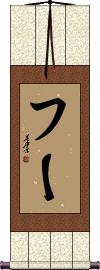
3. Foo
4. Food
8. Even The 100-Foot Bamboo Can Grow One More Foot
千慮一得 means “1000 tries, one success,” or “[a] thousand tries [leads to] one success.”
This proverb is a humble way to express your success, ideas, or accomplishments. As if you are a fool who just got lucky in inventing or creating something.
Translations for this proverb include:
Even without any notable ability on my part, I may still get it right sometimes by good luck.
Even a fool may sometimes come up with a good idea.
Compare this to the English idiom, “Even a broken clock is right twice a day.”
美式橄欖球 is the Chinese title for “American football” (not to be confused with international football known as soccer in the USA).
If you are a player or fan of American football, this will make a great wall scroll for your home.
The first two characters mean “American style.”
The last three characters mean football or rugby (a game involving an oblong or ovoid ball).
The “American” adjective is needed in this title to differentiate between Canadian football, Australian rules football, and rugby.
See Also: Soccer
アメフト is a short word that means “American football” in Japanese.
It is supposed to sound like an abbreviated version, “ame futo” which sounds like “ah-may foot-oh” (American Football).
There's not a great standard way to say “football” in Japanese, as the sport is not popular in Japan. Other Japanese terms for football can be confused with soccer or rugby.
Note: Because this title is entirely Japanese Katakana, it should be written by a Japanese calligrapher.
See Also: Soccer
アメリカンフットボール is the full/long title for “American football” in Japanese Katakana.
It is “Amerikan Futtoboru” which is supposed to sound like “American Football.”
Note: Because this title is entirely Japanese Katakana, it should be written by a Japanese calligrapher.
See Also: Soccer
食物 means food in Chinese, Japanese Kanji, and old Korean Hanja.
This can also be translated as edibles, foodstuffs, nourishment, or sustenance.
フットボール is one of a few different titles for football in Japan.
This one is supposed to sound like the international word “football / futbol.”
Note: This word is seldom if ever associated with the sport of American football.
Note: Because this title is entirely Japanese Katakana, it should be written by a Japanese calligrapher.
足球 is the word for football or soccer in Chinese.
As with most of the world, football is very popular in China. During the World Cup, the whole country seems to shut down to watch (regardless of whether Team China is playing or not).
Soccer is probably the 3rd most popular participation sport in China (after ping pong and badminton).
As you might expect, the first character means “foot” and the second character means “ball.”
FYI: This game would never be confused with American Football in Chinese. As with the rest of the world, there is a vague awareness of what American Football is (often described as "that game kind of like rugby").
For those familiar with American Football, there is some disgust regarding the fact that winners of the Superbowl call themselves "world champions" of a game that is only played in the USA. This is one of the reasons that jokes abound about how Americans are unaware that there is a world outside of their borders.
蹴球 is the title for football or soccer in Japanese Kanji and old Korean Hanja.
The sport is very popular in both Japan and Korea (Korea and Japan co-hosted the football World Cup in 2002 - a world-class sporting event held every four years that rivals the Olympics).
In Japan, they sometimes say サッカ (sakka) or フットボール (futto bouru) in place of the pronunciation shown above. 蹴球 is supposed to sound like the English word soccer and football/futbol respectively.
The first Kanji means kick and the second means ball. So technically, this means “kick ball” in Japanese and Korean (this is just an educational note - this will always be understood as the game of soccer/football).
FYI: This game would never be confused with American Football in Japan or Korea. Unlike the game of American basketball and baseball (both quite popular in Japan and Korea), there is only a vague awareness of a rugby-like game that is also called football in the USA.
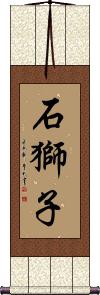
While known in the west as fu dogs or foo dogs, these are actually guardian lions.
These are the lion statues traditionally placed at the entrance of Chinese imperial palaces, imperial tombs, temples, and high-ranking officials' homes. These days, you are more likely to see them at the entrance to a fancy Chinese restaurant.
石獅子 means “stone lion(s).”
人為財死鳥為食亡 is a Chinese proverb that literally states that human beings will die for riches, just as birds will for food.
Figuratively it means that man will do anything in his means to become rich. Personally, I think dying for food is a more noble cause.
Often translated as “Men die in pursuit of wealth, birds die in pursuit of food. The 人 in this proverb just means human, so “men” is a placeholder for human with that translation - an English language problem that we have no easy gender-neutral nouns.
This proverb is meant to serve as a warning about the follies of greed.
君子豹変す is a Japanese proverb that suggests that a wise man is willing to change his mind, but a fool will stubbornly never change his.
The first word is 君子 (kunshi), a man of virtue, a person of high rank, a wise man.
The second word is 豹変 (hyouhen), sudden change, complete change.
The last part, す (su), modifies the verb to a more humble form.
The “fool” part is merely implied or understood. So if wise and noble people are willing to change their minds, it automatically says that foolish people are unwilling to change.
The following table may be helpful for those studying Chinese or Japanese...
| Title | Characters | Romaji (Romanized Japanese) | Various forms of Romanized Chinese | |
| Even a fool may sometimes come up with a good idea | 千慮一得 千虑一得 | senryonoittoku | qiān lǜ yī dé qian1 lv4 yi1 de2 qian lv yi de qianlvyide | ch`ien lü i te chienlüite chien lü i te |
| American Football | 美式橄欖球 美式橄榄球 | měi shì gǎn lǎn qiú mei3 shi4 gan3 lan3 qiu2 mei shi gan lan qiu meishiganlanqiu | mei shih kan lan ch`iu meishihkanlanchiu mei shih kan lan chiu |
|
| American Football | アメフト | ame futou / amefutou / ame futo | ||
| American Football | アメリカンフットボール | a me ri kan fu tto bo ru amerikanfuttoboru | ||
| Foo | フー | fuu / fu | ||
| Food | 食物 | shoku motsu shokumotsu | shí wù / shi2 wu4 / shi wu / shiwu | shih wu / shihwu |
| Football Futbol | フットボール | futto bouru futtobouru futto boru | ||
| Soccer Football Futbol | 足球 | zú qiú / zu2 qiu2 / zu qiu / zuqiu | tsu ch`iu / tsuchiu / tsu chiu | |
| Soccer Football Futbol | 蹴球 | shuu kyuu / shuukyuu / shu kyu | ||
| Fu Dog Foo Dog | 石獅子 石狮子 | shí shī zi shi2 shi1 zi5 shi shi zi shishizi | shih shih tzu shihshihtzu |
|
| Even The 100-Foot Bamboo Can Grow One More Foot | 百尺竿頭更進一步 百尺竿头更进一步 | bǎi chǐ gān tóu gèng jìng yī bù bai3 chi3 gan1 tou2 geng4 jing4 yi1 bu4 bai chi gan tou geng jing yi bu baichigantougengjingyibu | pai ch`ih kan t`ou keng ching i pu pai chih kan tou keng ching i pu |
|
| Men Die for Wealth, Birds Die for Food | 人為財死鳥為食亡 人为财死鸟为食亡 | rén wèi cái sǐ niǎo wèi shí wáng ren2 wei4 cai2 si3 niao3 wei4 shi2 wang2 ren wei cai si niao wei shi wang | jen wei ts`ai ssu niao wei shih wang jen wei tsai ssu niao wei shih wang |
|
| A Wise Man Changes His Mind (but a fool never will) | 君子豹変す | kun shi hyou hen su kunshihyouhensu kun shi hyo hen su | ||
| In some entries above you will see that characters have different versions above and below a line. In these cases, the characters above the line are Traditional Chinese, while the ones below are Simplified Chinese. | ||||
All of our calligraphy wall scrolls are handmade.
When the calligrapher finishes creating your artwork, it is taken to my art mounting workshop in Beijing where a wall scroll is made by hand from a combination of silk, rice paper, and wood.
After we create your wall scroll, it takes at least two weeks for air mail delivery from Beijing to you.
Allow a few weeks for delivery. Rush service speeds it up by a week or two for $10!
When you select your calligraphy, you'll be taken to another page where you can choose various custom options.
The wall scroll that Sandy is holding in this picture is a "large size"
single-character wall scroll.
We also offer custom wall scrolls in small, medium, and an even-larger jumbo size.
Professional calligraphers are getting to be hard to find these days.
Instead of drawing characters by hand, the new generation in China merely type roman letters into their computer keyboards and pick the character that they want from a list that pops up.
There is some fear that true Chinese calligraphy may become a lost art in the coming years. Many art institutes in China are now promoting calligraphy programs in hopes of keeping this unique form
of art alive.
Even with the teachings of a top-ranked calligrapher in China, my calligraphy will never be good enough to sell. I will leave that to the experts.
The same calligrapher who gave me those lessons also attracted a crowd of thousands and a TV crew as he created characters over 6-feet high. He happens to be ranked as one of the top 100 calligraphers in all of China. He is also one of very few that would actually attempt such a feat.
Some people may refer to this entry as Foo Kanji, Foo Characters, Foo in Mandarin Chinese, Foo Characters, Foo in Chinese Writing, Foo in Japanese Writing, Foo in Asian Writing, Foo Ideograms, Chinese Foo symbols, Foo Hieroglyphics, Foo Glyphs, Foo in Chinese Letters, Foo Hanzi, Foo in Japanese Kanji, Foo Pictograms, Foo in the Chinese Written-Language, or Foo in the Japanese Written-Language.