I am shipping orders on Thursday this week. News and More Info

The Name Dea in Japanese/Chinese on a Custom-Made Wall Scroll.

Click the "Customize" button next to your name below to start your personalized dea calligraphy artwork...

Switched to secondary search mode due to lack of results using primary.
These secondary results may not be very accurate. Try a different but similar meaning word or phrase for better results. Or...

Look up Dea in my Japanese Kanji & Chinese Character Dictionary(My dictionary is a different system then the calligraphy search you just tried)

If you want a special phrase, word, title, name, or proverb, feel free to contact me, and I will translate your custom calligraphy idea for you.


  1. Even a fool may sometimes come up with a good idea

  2. 6. Right Effort / Right Endeavor / Perfect Effort

  3. Death Before Dishonor

  4. Dea

  5. Deadra

  6. Deaken

  7. Dean

  8. Deana

  9. Deandre

10. Deangelo

11. Deanna

12. Deanne

13. Death Before Surrender

14. Death Before Dishonor

15. Death with Dignity

16. Death Before Surrender

17. Honorable Death - No Surrender

18. Deaven

19. Great Endeavor / To Strive

20. Dear Grandfather

21. Dear Grandmother

22. Grim Reaper / God of Death

23. Idea / Concept

24. Idea / Thought

25. Idea / Thought / Meaning

26. Nadeali

27. Return From Death’s Door

28. Sword of Death

29. Birth Old-Age Sickness Death

30. Thought / Thinking / Idea


Even a fool may sometimes come up with a good idea

 qiān lǜ yī dé
 senryonoittoku
Even a fool may sometimes come up with a good idea Scroll

千慮一得 means “1000 tries, one success,” or “[a] thousand tries [leads to] one success.”

This proverb is a humble way to express your success, ideas, or accomplishments. As if you are a fool who just got lucky in inventing or creating something.

Translations for this proverb include:
Even without any notable ability on my part, I may still get it right sometimes by good luck.
Even a fool may sometimes come up with a good idea.

Compare this to the English idiom, “Even a broken clock is right twice a day.”

6. Right Effort / Right Endeavor / Perfect Effort

Samyag Vyayama / Samma Vayama

 zhèng jīng jìn
 sei shou jin
6. Right Effort / Right Endeavor / Perfect Effort Scroll

正精進 is one of the Noble Eightfold Paths of Buddhism. Right Effort, along with Right Mindfulness and Right Concentration, constitute the path to Concentration or Perfect Thought.

The proper effort is not the effort to make something particular happen. It is the effort to be aware and awake in each moment, the effort to overcome laziness and defilement, and the effort to make each activity of our daily meditation. This concept is about pursuing wholesome things that promote good karma.

Another definition: Cultivation of what is karmically wholesome and avoidance of what is karmically unwholesome.


This term is exclusively used by devout Buddhists. It is not a common term, and is remains an unknown concept to most Japanese and Chinese people.


See Also:  Buddhism | Enlightenment | Noble Eightfold Path

Death Before Dishonor

Better to be broken jade than unbroken pottery

 níng wéi yù suì
Death Before Dishonor Scroll

寧為玉碎 is the short version of a longer Chinese proverb which means “rather be shattered piece of jade than an unbroken piece of pottery.”

寧為玉碎 says the “rather be a broken piece of jade” part (the second half is implied - everyone in China knows this idiom).

A little more explanation:
Death is implied with the “broken” meaning. Jade is one of the most precious materials in Chinese history, and in this case, is compared with one's honor and self-worth. Pottery is just something you eat off of; it has no deep value, just as a person who has lost their honor or had none to begin with.
Thus, this means “better to die with honor than to live in shame” or words to that effect.

This is often translated in English as “Death Before Dishonor,” the famous military slogan.

I would also compare this to the English proverb, “Better to die on your feet than to live on your knees.”

Death Before Dishonor

Better to be broken jade than unbroken pottery

 níng wéi yù suì bù wéi wǎ quán
Death Before Dishonor Scroll

寧為玉碎不為瓦全 is the long version of a Chinese proverb that means “rather be shattered piece of jade than an unbroken piece of pottery.”

A little more explanation:
Death is implied with the “broken” meaning. Jade is one of the most precious materials in Chinese history, and in this case, is compared with one's honor and self-worth. Pottery is just something you eat off of, it has no deep value, just as a person who has lost their honor, or had none to begin with.
Thus, this means “better to die with honor than to live in shame” or words to that effect.

寧為玉碎不為瓦全 is often translated in English as “Death Before Dishonor,” the famous military slogan.

I would also compare this to the English proverb, “Better to die on your feet than to live on your knees.”


This is an idiom. It therefore doesn’t directly say exactly what it means. If you think about the English idiom, "The grass is always greener," it does not directly say "jealousy" or "envy" but everyone knows that it is implied.

 deea
Dea Scroll

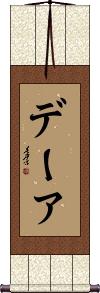
デーア is the name Dea in Japanese Katakana.


Note: Because this title is entirely Japanese Katakana, it should be written by a Japanese calligrapher.

 dí dé lā
Deadra Scroll

迪德拉 is the name Deadra in Chinese (Mandarin).

 deedora
Deadra Scroll

デードラ is the name Deadra in Japanese (Katakana).


Note: Because this title is entirely Japanese Katakana, it should be written by a Japanese calligrapher.

 dí kěn
Deaken Scroll

迪肯 is the name Deaken in Chinese (Mandarin).

 diiken
Deaken Scroll

ディーケン is the name Deaken in Japanese Katakana.


Note: Because this title is entirely Japanese Katakana, it should be written by a Japanese calligrapher.

 dí ēn
Dean Scroll

迪恩 is the name Dean in Chinese (Mandarin).

 diin
Dean Scroll

ディーン is the name Dean in Japanese.


Note: Because this title is entirely Japanese Katakana, it should be written by a Japanese calligrapher.

 dí nà
Deana Scroll

迪納 is the name Deana in Chinese (Mandarin).

 diana
Deana Scroll

ディアナ is the name Deana in Japanese (Katakana).


Note: Because this title is entirely Japanese Katakana, it should be written by a Japanese calligrapher.

 dé ān dé lǔ
Deandre Scroll

德安德魯 is the name Deandre in Chinese (Mandarin).

 diandore
Deandre Scroll

ディアンドレ is the name Deandre in Japanese (Katakana).


Note: Because this title is entirely Japanese Katakana, it should be written by a Japanese calligrapher.

 dí ān jié luò
Deangelo Scroll

迪安杰洛 is the name Deangelo in Chinese (Mandarin).

 deanjero
Deangelo Scroll

デアンジェロ is the name Deangelo in Japanese Katakana.


Note: Because this title is entirely Japanese Katakana, it should be written by a Japanese calligrapher.

 dí ān nà
Deanna Scroll

迪安娜 is the transliteration to Mandarin Chinese for the English name Deanna.

 diina
Deanna Scroll

ヂイナ is the name Deanna in Japanese.


Note: Because this title is entirely Japanese Katakana, it should be written by a Japanese calligrapher.

 dian
Deanne Scroll

ディアン is the name Deanne in Japanese Katakana.


Note: Because this title is entirely Japanese Katakana, it should be written by a Japanese calligrapher.

Death Before Surrender

Rather die than compromise

 níng sǐ bù qū
Death Before Surrender Scroll

寧死不屈 is often translated as “Death Before Dishonor.”

The literal translation is more like, “Better die than compromise.” The last two characters mean “not to bend” or “not to bow down.” Some might even say that it means “not to surrender.” Thus, you could say this proverb means “Better to die than live on my knees” or simply “no surrender” (with the real idea being that you would rather die than surrender).

Death Before Dishonor

You can die or kill, but never dishonor or disgrace yourself

 kě shā bù kě rǔ
Death Before Dishonor Scroll

可殺不可辱 almost directly matches the idea of “Death Before Dishonor” while also being an ancient Chinese proverb.

The direct meaning is, “[you] can die/kill [but you] cannot [allow] dishonor/disgrace [upon yourself].” Chinese grammar, and especially ancient grammar, is a little different than English. Not nearly as many articles are needed, and a lot is implied.

There are many ways to express ideas similar to “Death Before Dishonor” in Chinese, and I would rate this one in the top two.

Death Before Dishonor

A soldier can die or kill, but never dishonor or disgrace himself

 shì kě shā bù kě rǔ
Death Before Dishonor Scroll

士可殺不可辱 almost directly matches the military idea of “Death Before Dishonor,” while also being an ancient Chinese proverb.

The direct meaning is, “[A] soldier/warrior can die/kill [but he/she] cannot [allow] dishonor/disgrace [upon himself/herself].” Chinese grammar, and especially ancient grammar, is a little different than English. Not nearly as many articles are needed, and a lot is implied.

There are a lot of ways to express ideas similar to “Death Before Dishonor” in Chinese, and I would rate this one in the top two.

This is the original form of this proverb with the character for “soldier/warrior” at the beginning. Most of the time, this character is dropped, becoming a five-character proverb (the soldier/warrior part is implied, even without the character being present in the proverb). We also offer a shorter version.

Death Before Dishonor

 fu mei yo yo ri shi
Death Before Dishonor Scroll

不名誉より死 is the Japanese version of “Death Before Dishonor.”

Japanese grammar is a bit different than English, so this really means something like “Rather die than to be dishonored.” However, “dishonor” is the first three Kanji, and death is the last Kanji. There are two Hiragana (より) which indicate the preference is death when comparing dishonor to death.


Note: Because this selection contains some special Japanese Hiragana characters, it should be written by a Japanese calligrapher.

Death with Dignity

 son gen shi
Death with Dignity Scroll

尊厳死 is not a good choice for a wall scroll unless you have a very specific and personal reason.

This was added at the request of a customer.

尊厳死 means “death with dignity” or “natural death” (as opposed to extending one's life unnaturally with life support).

Death Before Surrender

 nìng sǐ bù xiáng
Death Before Surrender Scroll

寧死不降 is an ancient Chinese proverb that can be translated as “Rather die than surrender,” “Prefer death over surrender,” “To prefer death to surrender,” or simply “No surrender.”

This is probably the closest proverb to the English proverb “Better to die on your feet than to live on your knees.”

Honorable Death - No Surrender

 gyokusai shugi
Honorable Death - No Surrender Scroll

This ancient Japanese proverb can be translated as “The principle of honorable death and no surrender,” or simply “No surrender.”

If you directly translate this, you get something that means “Doctrine of suicide,” or “Ideology of honorable death.”

玉砕主義 is a specifically-Japanese proverb that embraces the long history of honorable suicide or self-sacrifice for honor in Japanese culture.

 dí wén
Deaven Scroll

迪文 is the name Deaven in Chinese (Mandarin).

 diabun
Deaven Scroll

ディアブン is the name Deaven in Japanese (Katakana).


Note: Because this title is entirely Japanese Katakana, it should be written by a Japanese calligrapher.

Great Endeavor / To Strive

 nǔ lì
 doryoku
Great Endeavor / To Strive Scroll

努力 means great effort; to strive; to try hard; great effort; great exertion; great endeavor (endeavour); great effort; to strive.

This “striving endeavor” word is valid in Chinese, Japanese Kanji, and old Korean Hanja.

Dear Grandfather

Maternal (Northern China)

 qín ài de lǎo ye
Dear Grandfather Scroll

親愛的姥爺 is what you would call your maternal grandfather (mother's father) in Northern China with the adjective/title “Dear” on the front.

Dear Grandfather

Maternal (Southern China)

 qín ài de wài zǔ fù
Dear Grandfather Scroll

親愛的外祖父 is the formal way that people in Southern China usually call their mother's father (maternal grandfather) with the adjective/title “Dear” on the front.

Dear Grandfather

Maternal (Southern China - Informal)

 qín ài de wài gōng
Dear Grandfather Scroll

親愛的外公 is an informal way to call your maternal grandfather (mother's father) in Southern China with the adjective/title “Dear” on the front.

Dear Grandfather

Paternal (Northern China)

 qín ài de yé ye
Dear Grandfather Scroll

親愛的爺爺 is the most common way for people in Northern China to refer to their father's father (paternal grandfather) with the adjective/title “Dear” on the front.

Dear Grandfather

Paternal (Southern China)

 qín ài de zǔ fù
Dear Grandfather Scroll

親愛的祖父 is how people in Southern China call their father's father (paternal grandfather) with the adjective/title “Dear” on the front.

Dear Grandmother

Maternal (Northern China)

 qín ài de lǎo lao
Dear Grandmother Scroll

親愛的姥姥 is the common way to refer to your mother's mother (maternal grandmother) in Northern China with the adjective/title “Dear” on the front.

Dear Grandmother

Maternal (Southern China)

 qín ài de wài pó
Dear Grandmother Scroll

親愛的外婆 is a common way to refer to your mother's mother (maternal grandmother) in Southern China with the adjective/title “Dear” on the front.

Dear Grandmother

Maternal (Southern China - formal)

 qín ài de wài zǔ mǔ
Dear Grandmother Scroll

亲爱的外祖母 is the formal way to refer to your mother's mother (maternal grandmother) in Southern China with the adjective/title “Dear” on the front.

Dear Grandmother

Paternal (Northern China)

 qín ài de nǎi nai
Dear Grandmother Scroll

親愛的奶奶 is probably the most common way to refer to your father's mother (paternal grandmother) in northern China with the adjective/title “Dear” on the front.

Dear Grandmother

Paternal (Southern China)

 qín ài de zǔ mǔ
Dear Grandmother Scroll

The most common way to refer to your father's mother (paternal grandmother) in Southern China with the adjective/title “Dear” on the front.

Grim Reaper / God of Death

 sǐ shén
 shinigami
Grim Reaper / God of Death Scroll

死神 is the title of the mythological figure (often called the Grim Reaper in western culture) in charge of taking the souls of those who die.

This title can be translated directly as “god of death” or “spirit of death.” The first character literally means “death,” and the second means “spirit” or “god.”

死神 is a very strange title for a calligraphy wall scroll. I'm not even sure if my calligraphers will write it, as it has some bad superstitious feelings attached to it.

Idea / Concept

 lǐ niàn
 ri nen
Idea / Concept Scroll

理念/理唸 means idea, notion, concept, principle, theory, philosophy*, or doctrine in Chinese, Japanese Kanji, and old Korean Hanja.

This word is OK for a wall scroll, although it's more commonly used as an oral/informal word in Asia.

* This is not the title for philosophy but rather is about having a certain philosophy or approach to something.

Idea / Thought

 yì niàn
Idea / Thought Scroll

意念/意唸 means idea or thought in Chinese.

Idea / Thought

 yì jiàn
 i ken
Idea / Thought Scroll

意見 means idea, thought, opinion, or view in Japanese.

This word also has a similar meaning in Chinese, just often used in China.

Idea / Thought / Meaning

 yì
 kokoro
 
Idea / Thought / Meaning Scroll

意 is the Chinese, Japanese Kanji, and old Korean Hanja for an idea, intention, meaning, thought, wish, desire, intention, feelings, and thoughts.

In Buddhism, this is the last of the six means of perception (the others are sight, hearing, smell, taste, and touch, and this one represents the mind). It does not literally mean “mind,” but rather something more like mental powers, intellect, intelligence, faculty of thought, or understanding in the Buddhist context.

 nà dí ā lǐ
Nadeali Scroll

納迪阿里 is the name Nadeali in Chinese (Mandarin).

 nadeari
Nadeali Scroll

ナデアリ is the name Nadeali in Japanese Katakana.


Note: Because this title is entirely Japanese Katakana, it should be written by a Japanese calligrapher.

Return From Death’s Door

 jué chǔ féng shēng
Return From Death’s Door Scroll

絕處逢生 is a Chinese proverb/idiom that talks of coming back from death's door or an unexpected rescue from danger.

Figuratively, this can be to recover from a seemingly impossible situation or to find a way out of a predicament.

If you have survived a near-death experience or severe illness, this might be an appropriate wall scroll for you.

Sword of Death

 satsu jin ken
Sword of Death Scroll

殺人剣 is a Japanese title for “Death Sword,” “Life Taking Sword,” or “satsujinken.”

This is the opposite of katsujinken or the “life-saving sword.” This title is not as commonly used in Japanese but pairs well when hung with katsujinken.

The first two Kanji are a word that translates as homicide, murder or kill (a person). 殺人剣 is specifically to kill a person (as the second character means person or human) as opposed to an animal, etc.

The last Kanji is the Japanese variant of the originally-Chinese character for a sword.


See Also:  Katsujinken

Birth Old-Age Sickness Death

Born to Suffer

 shēng lǎo bìng sǐ
 shou rou byou shi
Birth Old-Age Sickness Death Scroll

生老病死 means “to be born, to grow old, to get sick and to die” or “birth, aging, sickness, and death.”

This is an old somewhat-morbid Chinese proverb that is also used in Korean and Japanese. It figuratively means the fate of humankind (i.e. mortality) or suggests that we are all born to suffer.

In the Buddhist context, there are the “four inevitables in human life” or “four afflictions that are the lot of every human” known as “四苦” (literally “four afflictions”). Sometimes this proverb is written with that affliction character, 苦, at the end like 生老病死苦.

Thought / Thinking / Idea

 sī xiǎng
 shisou
Thought / Thinking / Idea Scroll

思想 means thought, thinking, or idea in Chinese, Japanese Kanji, and old Korean Hanja. Sometimes it can mean ideology, depending on context.

This can refer to someone's personality - like saying, “he is a thinker.”


The following table may be helpful for those studying Chinese or Japanese...

Title CharactersRomaji (Romanized Japanese)Various forms of Romanized Chinese
Even a fool may sometimes come up with a good idea千慮一得
千虑一得
senryonoittokuqiān lǜ yī dé
qian1 lv4 yi1 de2
qian lv yi de
qianlvyide
ch`ien lü i te
chienlüite
chien lü i te
6. Right Effort
Right Endeavor
Perfect Effort
正精進
正精进
sei shou jin
seishoujin
sei sho jin
zhèng jīng jìn
zheng4 jing1 jin4
zheng jing jin
zhengjingjin
cheng ching chin
chengchingchin
Death Before Dishonor寧為玉碎
宁为玉碎
níng wéi yù suì
ning2 wei2 yu4 sui4
ning wei yu sui
ningweiyusui
ning wei yü sui
ningweiyüsui
Death Before Dishonor寧為玉碎不為瓦全
宁为玉碎不为瓦全
níng wéi yù suì bù wéi wǎ quán
ning2 wei2 yu4 sui4 bu4 wei2 wa3 quan2
ning wei yu sui bu wei wa quan
ningweiyusuibuweiwaquan
ning wei yü sui pu wei wa ch`üan
ning wei yü sui pu wei wa chüan
Deaデーアdeea / dea
Deadra迪德拉dí dé lā
di2 de2 la1
di de la
didela
ti te la
titela
Deadraデードラdeedora / dedora
Deaken迪肯dí kěn / di2 ken3 / di ken / dikenti k`en / tiken / ti ken
Deakenディーケンdiiken / diken
Dean迪恩dí ēn / di2 en1 / di en / dienti en / tien
Deanディーンdiin / din
Deana迪納
迪纳
dí nà / di2 na4 / di na / dinati na / tina
Deanaディアナdiana
Deandre德安德魯
德安德鲁
dé ān dé lǔ
de2 an1 de2 lu3
de an de lu
deandelu
te an te lu
teantelu
Deandreディアンドレdiandore
Deangelo迪安杰洛dí ān jié luò
di2 an1 jie2 luo4
di an jie luo
dianjieluo
ti an chieh lo
tianchiehlo
Deangeloデアンジェロdeanjero
Deanna迪安娜dí ān nà
di2 an1 na4
di an na
dianna
ti an na
tianna
Deannaヂイナdiina / dina
Deanneディアンdian
Death Before Surrender寧死不屈
宁死不屈
níng sǐ bù qū
ning2 si3 bu4 qu1
ning si bu qu
ningsibuqu
ning ssu pu ch`ü
ningssupuchü
ning ssu pu chü
Death Before Dishonor可殺不可辱
可杀不可辱
kě shā bù kě rǔ
ke3 sha1 bu4 ke3 ru3
ke sha bu ke ru
keshabukeru
k`o sha pu k`o ju
koshapukoju
ko sha pu ko ju
Death Before Dishonor士可殺不可辱
士可杀不可辱
shì kě shā bù kě rǔ
shi4 ke3 sha1 bu4 ke3 ru3
shi ke sha bu ke ru
shikeshabukeru
shih k`o sha pu k`o ju
shihkoshapukoju
shih ko sha pu ko ju
Death Before Dishonor不名譽より死
不名誉より死
fu mei yo yo ri shi
fumeiyoyorishi
Death with Dignity尊厳死son gen shi
songenshi
Death Before Surrender寧死不降
宁死不降
nìng sǐ bù xiáng
ning4 si3 bu4 xiang2
ning si bu xiang
ningsibuxiang
ning ssu pu hsiang
ningssupuhsiang
Honorable Death - No Surrender玉砕主義gyokusai shugi
gyokusaishugi
Deaven迪文dí wén / di2 wen2 / di wen / diwenti wen / tiwen
Deavenディアブンdiabun
Great Endeavor
To Strive
努力doryoku / doryokunǔ lì / nu3 li4 / nu li / nuli
Dear Grandfather親愛的姥爺
亲爱的姥爷
qín ài de lǎo ye
qin2 ai4 de lao3 ye
qin ai de lao ye
qinaidelaoye
ch`in ai te lao yeh
chinaitelaoyeh
chin ai te lao yeh
Dear Grandfather親愛的外祖父
亲爱的外祖父
qín ài de wài zǔ fù
qin2 ai4 de wai4 zu3 fu4
qin ai de wai zu fu
qinaidewaizufu
ch`in ai te wai tsu fu
chinaitewaitsufu
chin ai te wai tsu fu
Dear Grandfather親愛的外公
亲爱的外公
qín ài de wài gōng
qin2 ai4 de wai4 gong1
qin ai de wai gong
qinaidewaigong
ch`in ai te wai kung
chinaitewaikung
chin ai te wai kung
Dear Grandfather親愛的爺爺
亲爱的爷爷
qín ài de yé ye
qin2 ai4 de ye2 ye
qin ai de ye ye
qinaideyeye
ch`in ai te yeh yeh
chinaiteyehyeh
chin ai te yeh yeh
Dear Grandfather親愛的祖父
亲爱的祖父
qín ài de zǔ fù
qin2 ai4 de zu3 fu4
qin ai de zu fu
qinaidezufu
ch`in ai te tsu fu
chinaitetsufu
chin ai te tsu fu
Dear Grandmother親愛的姥姥
亲爱的姥姥
qín ài de lǎo lao
qin2 ai4 de lao3 lao
qin ai de lao lao
qinaidelaolao
ch`in ai te lao lao
chinaitelaolao
chin ai te lao lao
Dear Grandmother親愛的外婆
亲爱的外婆
qín ài de wài pó
qin2 ai4 de wai4 po2
qin ai de wai po
qinaidewaipo
ch`in ai te wai p`o
chinaitewaipo
chin ai te wai po
Dear Grandmother親愛的外祖母
亲爱的外祖母
qín ài de wài zǔ mǔ
qin2 ai4 de wai4 zu3 mu3
qin ai de wai zu mu
qinaidewaizumu
ch`in ai te wai tsu mu
chinaitewaitsumu
chin ai te wai tsu mu
Dear Grandmother親愛的奶奶
亲爱的奶奶
qín ài de nǎi nai
qin2 ai4 de nai3 nai
qin ai de nai nai
qinaidenainai
ch`in ai te nai nai
chinaitenainai
chin ai te nai nai
Dear Grandmother親愛的祖母
亲爱的祖母
qín ài de zǔ mǔ
qin2 ai4 de zu3 mu3
qin ai de zu mu
qinaidezumu
ch`in ai te tsu mu
chinaitetsumu
chin ai te tsu mu
Grim Reaper
God of Death
死神shinigamisǐ shén / si3 shen2 / si shen / sishenssu shen / ssushen
Idea
Concept
理念 / 理唸
理念
ri nen / rinenlǐ niàn / li3 nian4 / li nian / linianli nien / linien
Idea
Thought
意念 / 意唸
意念
yì niàn / yi4 nian4 / yi nian / yiniani nien / inien
Idea
Thought
意見i ken / ikenyì jiàn / yi4 jian4 / yi jian / yijiani chien / ichien
Idea
Thought
Meaning
kokoroyì / yi4 / yii
Nadeali納迪阿里
纳迪阿里
nà dí ā lǐ
na4 di2 a1 li3
na di a li
nadiali
na ti a li
natiali
Nadealiナデアリnadeari
Return From Death’s Door絕處逢生
绝处逢生
jué chǔ féng shēng
jue2 chu3 feng2 sheng1
jue chu feng sheng
juechufengsheng
chüeh ch`u feng sheng
chüehchufengsheng
chüeh chu feng sheng
Sword of Death殺人剣
杀人剣
satsu jin ken
satsujinken
Birth Old-Age Sickness Death生老病死shou rou byou shi
shouroubyoushi
sho ro byo shi
shēng lǎo bìng sǐ
sheng1 lao3 bing4 si3
sheng lao bing si
shenglaobingsi
sheng lao ping ssu
shenglaopingssu
Thought
Thinking
Idea
思想shisou / shisosī xiǎng / si1 xiang3 / si xiang / sixiangssu hsiang / ssuhsiang
In some entries above you will see that characters have different versions above and below a line.
In these cases, the characters above the line are Traditional Chinese, while the ones below are Simplified Chinese.


Dictionary

Lookup Dea in my Japanese & Chinese Dictionary

All of our calligraphy wall scrolls are handmade.

When the calligrapher finishes creating your artwork, it is taken to my art mounting workshop in Beijing where a wall scroll is made by hand from a combination of silk, rice paper, and wood.
After we create your wall scroll, it takes at least two weeks for air mail delivery from Beijing to you.

Allow a few weeks for delivery. Rush service speeds it up by a week or two for $10!

When you select your calligraphy, you'll be taken to another page where you can choose various custom options.


A nice Chinese calligraphy wall scroll

The wall scroll that Sandy is holding in this picture is a "large size"
single-character wall scroll.
We also offer custom wall scrolls in small, medium, and an even-larger jumbo size.

A professional Chinese Calligrapher

Professional calligraphers are getting to be hard to find these days.
Instead of drawing characters by hand, the new generation in China merely type roman letters into their computer keyboards and pick the character that they want from a list that pops up.

There is some fear that true Chinese calligraphy may become a lost art in the coming years. Many art institutes in China are now promoting calligraphy programs in hopes of keeping this unique form of art alive.

Trying to learn Chinese calligrapher - a futile effort

Even with the teachings of a top-ranked calligrapher in China, my calligraphy will never be good enough to sell. I will leave that to the experts.

A high-ranked Chinese master calligrapher that I met in Zhongwei

The same calligrapher who gave me those lessons also attracted a crowd of thousands and a TV crew as he created characters over 6-feet high. He happens to be ranked as one of the top 100 calligraphers in all of China. He is also one of very few that would actually attempt such a feat.


Some people may refer to this entry as Dea Kanji, Dea Characters, Dea in Mandarin Chinese, Dea Characters, Dea in Chinese Writing, Dea in Japanese Writing, Dea in Asian Writing, Dea Ideograms, Chinese Dea symbols, Dea Hieroglyphics, Dea Glyphs, Dea in Chinese Letters, Dea Hanzi, Dea in Japanese Kanji, Dea Pictograms, Dea in the Chinese Written-Language, or Dea in the Japanese Written-Language.