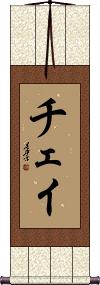
I am shipping orders on Saturday this week. News and More Info
Click the "Customize" button next to your name below to start your personalized che calligraphy artwork...
Switched to secondary search mode due to lack of results using primary.
These secondary results may not be very accurate. Try a different but similar meaning word or phrase for better results. Or...
Look up Che in my Japanese Kanji & Chinese Character Dictionary(My dictionary is a different system then the calligraphy search you just tried)
If you want a special phrase, word, title, name, or proverb, feel free to contact me, and I will translate your custom calligraphy idea for you.
1. Acher
2. Archer
3. Archey
4. Blanche
6. Blanchette
7. Canchela
8. Che
9. Che Guevara
10. Che
11. Checco
12. Chech
13. Cheech
14. Cheesman
15. Cheetah
16. Cheick
17. Cheko
18. Chel
19. Chell
20. Chelle
21. Chelsea
22. Chelsey
23. Chelsie
24. Chelsy
25. Chely
26. Chema
28. Chenelle
29. Cheo
30. Chepe
31. Cher
32. Cherel
33. Cherelle
34. Cheri
35. Cherie
36. Cherise
37. Cherish
38. Cherney
40. Cherry Blossom
41. Cherry
42. Cherrynn
43. Chery
44. Cheryl
45. Chesley
46. Chess
47. Chester
48. Chet
49. Chetan
50. Cheval
52. Chevel
53. Chevelle
54. Chevy
55. Chey
56. Cheyanne
射手 means archer, shooter, or marksman in Chinese, Japanese Kanji, and old Korean Hanja.
Depending on the context, it can also mean “goal-getter” in Chinese. This would also be the word for a bowman.
射手 is modern in Asia, meaning that it's only been in use for a few hundred years. However, the more ancient version of the archer is often not even recognized by the current generation of Chinese and Japanese people.
The first character means “shoot” or “fire” (in the context of a gun or bow). It's also a suffix for radioactive things (in the context of chemistry) - radioactive things “fire off” electrons. In Japanese, the first Kanji is a short name and suffix for archery.
The second character means “hand,” but the hand can also mean a person, in the same way, that a “farmhand” is a person in English.
Ancient title for Archer
弋人 is the ancient way to write archer in both Chinese, Korean and Japanese.
If you carried a bow into battle in an army of ancient Asia, this would be your title.
Note: 弋人 is an antiquated term that is rarely used in modern Chinese, Korean or Japanese. Beyond archer, this can also mean a ceremonial hunter in Japanese.
Note: This title is so old, that most Asian people will not recognize this as a normal word. It has not been in regular use for many generations.
Modern Chinese Version
弓箭手 is how to write “archer” in modern Chinese.
弓箭手 literally means “bow arrow hand.”
There are other ways to write “archer” in Chinese, but this is probably the most common title for modern China. The other, less-common version of “archer” is also more universal because it has the same meaning in Japanese (this one is not used in Japan).
Latin American / Cuban Revolutionary
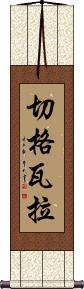
切格瓦拉 is the name “Che Guevara,” as written (transliterated) in Mandarin Chinese.

Once revered by Chinese people as a Socialist rebel, he's now just a historical figure that school children briefly learn about in China.
切格瓦拉 is because China used to be a truly-Communist/Socialist nation, and thus, other Communists and Socialists were heroes.
In modern China, with its free-market economy, those former heroes fade a little.
We are not offering the “Che” character alone, as few would associate it with Che Guevara, so you need the full name to be clear (minus Ernesto, which is his real first name).
Surname
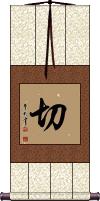
This is the most common character for a Chinese surname that romanizes as “Chen.”
This is also a surname You or Yo in Japanese, though it can also be pronounced as Chin in Japanese.
In Korean, it is a surname romanized as Jin.
As a word, this character means: to lay out; to exhibit; to display; to narrate; to state; to explain; to tell.
The Chen clan or family was a small kingdom from 1046 BC to 479 BC. It was one of 12 small-but-powerful vassal states during the Spring and Autumn Period 770-475 BC. This name reappeared as the Chen Dynasty (陳朝) of the Southern dynasties from 557 AD to 589 AD.
櫻 is the single-character (short) way to write “cherry blossom” or “cherry tree” in Chinese and traditional Japanese Kanji.
There is an alternate version of this character, which has become the standard for Japanese Kanji. If you want this version, instead of the one shown to the upper left, please click on the Kanji shown to the right instead of the button above. Although this is an alternate form in Chinese, most Chinese people will think this is just the Japanese version (Chinese people
don’t
necessarily know the history and all alternate forms of Chinese characters from the past). Therefore, this version shown to the right is best if your audience is Japanese (though most Japanese will recognize the form shown in the upper left).
櫻花 is how to write “cherry blossom” in Chinese and traditional Japanese Kanji.
The first character means “cherry” or sometimes “cherry tree.”
The second character means “flowers” or “blossoms.”
Oddly, my Chinese dictionary also defines these two characters as “Japanese oriental cherry tree” or “Oriental cherry blossom.” However, the first character is the only one that means “cherry,” so it can refer to any cherry blossoms in the whole world (not just those in Asia).
There is an alternate version of the first character, which has become the standard for Japanese Kanji. If you want this version, instead of the one shown to the upper left, please click on the Kanji shown to the right instead of the button above. Although this is an alternate form in Chinese, most Chinese people will think this is just the Japanese version (Chinese people
don’t
necessarily know the history and all alternate forms of Chinese characters from the past). Therefore, this version shown to the right is best if your audience is Japanese (though most Japanese will recognize the form shown in the upper left).
棋 is the most simple or generic way to write “chess” in Asia.
棋 is part of other more specific words for board games of strategy such as the western version of chess, Chinese chess, Weiqi, or Go.
In Japanese, this single character is pronounced “Go” and often refers to the game known in the west as “Go” (not just the 5-in-a-row version but also the complicated encirclement game of strategy known in China as Weiqi).
In Chinese, this can be more ambiguous as to which game of chess you speak.
If you like any version of chess, or games of intense strategy, this can be the character to hang on the wall in your game room.
All of our calligraphy wall scrolls are handmade.
When the calligrapher finishes creating your artwork, it is taken to my art mounting workshop in Beijing where a wall scroll is made by hand from a combination of silk, rice paper, and wood.
After we create your wall scroll, it takes at least two weeks for air mail delivery from Beijing to you.
Allow a few weeks for delivery. Rush service speeds it up by a week or two for $10!
When you select your calligraphy, you'll be taken to another page where you can choose various custom options.
The wall scroll that Sandy is holding in this picture is a "large size"
single-character wall scroll.
We also offer custom wall scrolls in small, medium, and an even-larger jumbo size.
Professional calligraphers are getting to be hard to find these days.
Instead of drawing characters by hand, the new generation in China merely type roman letters into their computer keyboards and pick the character that they want from a list that pops up.
There is some fear that true Chinese calligraphy may become a lost art in the coming years. Many art institutes in China are now promoting calligraphy programs in hopes of keeping this unique form
of art alive.
Even with the teachings of a top-ranked calligrapher in China, my calligraphy will never be good enough to sell. I will leave that to the experts.
The same calligrapher who gave me those lessons also attracted a crowd of thousands and a TV crew as he created characters over 6-feet high. He happens to be ranked as one of the top 100 calligraphers in all of China. He is also one of very few that would actually attempt such a feat.
Some people may refer to this entry as Che Kanji, Che Characters, Che in Mandarin Chinese, Che Characters, Che in Chinese Writing, Che in Japanese Writing, Che in Asian Writing, Che Ideograms, Chinese Che symbols, Che Hieroglyphics, Che Glyphs, Che in Chinese Letters, Che Hanzi, Che in Japanese Kanji, Che Pictograms, Che in the Chinese Written-Language, or Che in the Japanese Written-Language.